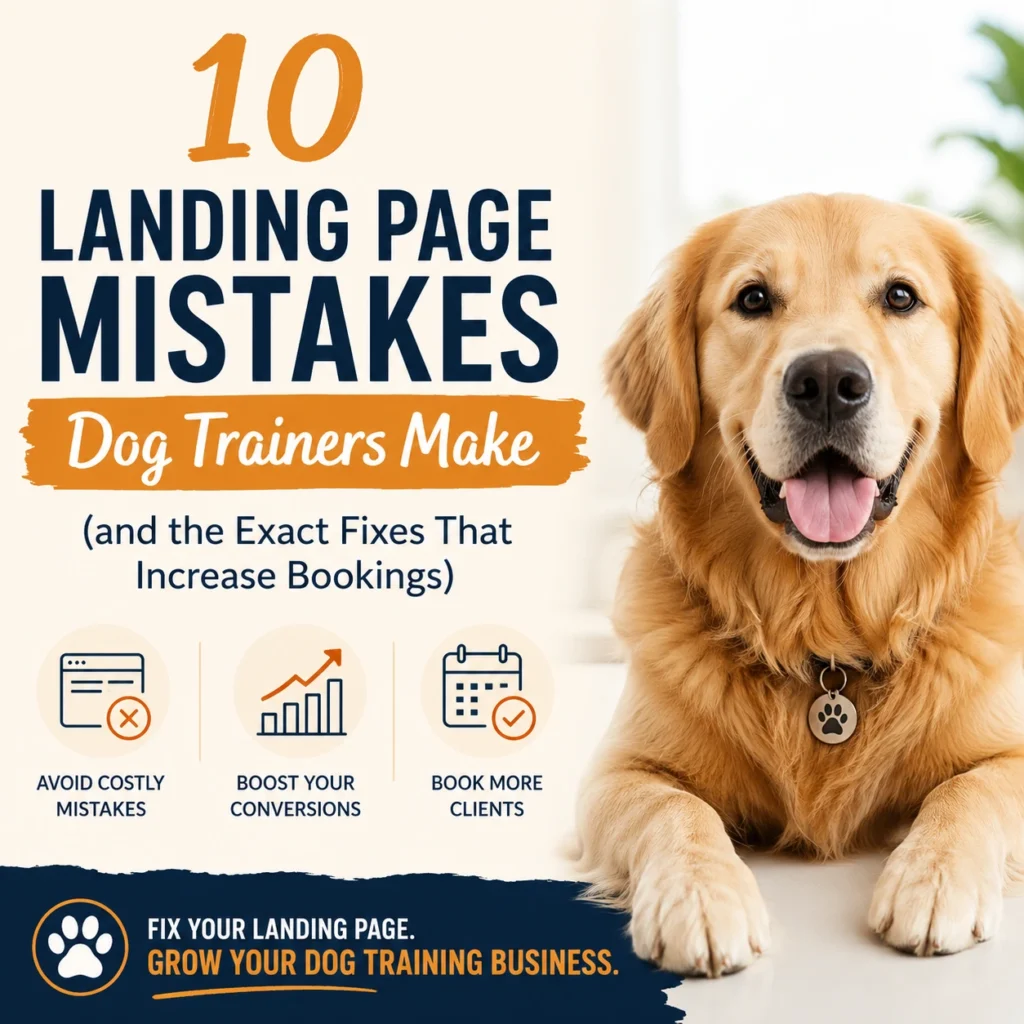
Why Landing Pages Matter More Than You Think
Dog trainers spend money on Google Ads. They run Facebook campaigns. They invest in paid traffic. But if their landing pages don’t convert, that money is wasted.
According to conversion optimization research, 85 percent of dog training businesses have landing pages that underperform. Average conversion rate is 2 to 3 percent. This means 97 to 98 percent of visitors leave without booking a consultation.
Compare this to optimized landing pages converting at 8 to 12 percent. A dog trainer sending 100 monthly visitors to a 2 percent converting page gets two consultations. The same 100 visitors to an 8 percent converting page generates eight consultations. Four times more clients from identical traffic.
This article reveals 10 common landing page mistakes dog trainers make and the exact fixes that increase conversion rates 200 to 400 percent.
Mistake 1: Unclear Value Proposition (Visitors Don’t Know What You Offer)
The Problem
Your landing page headline reads “Professional Dog Training” or “Expert Dog Trainer.” These headlines tell visitors you exist. They don’t tell visitors why they should care.
A visitor landing on your page asks an implicit question: “Can you help my specific dog with my specific problem?” If your headline doesn’t answer this question in the first three seconds, they leave.
Impact: Conversion rate stays at 1 to 2 percent because visitors aren’t sure if you can solve their problem.
The Fix
Your headline should immediately communicate what problem you solve and for whom.
Instead of: “Professional Dog Training”
Use: “Stop Your Dog’s Jumping and Aggression in 4 Weeks or Your Money Back”
Or: “Board and Train Program for Puppies with Guaranteed Obedience Results”
Or: “Reactive Dog Training: Leash Walking Again Without Fear”
Or: “Puppy Training for First-Time Dog Owners in [City]”
The fixed headline includes:
The specific problem you solve (jumping, aggression, reactivity)
Who you help (puppies, aggressive dogs, reactive dogs)
The outcome promised (stops in 4 weeks, guaranteed results, leash walking without fear)
Social proof or specificity (in [city], first-time owners, money back guarantee)
Action: Write five different headlines. A/B test them. Keep the one generating highest click-through rate from ads and highest conversion rate on the landing page.
Expected improvement: Conversion rate increases from 2-3 percent to 4-6 percent (100 to 200 percent improvement).
Mistake 2: Homepage Instead of Dedicated Landing Page (Generic Messaging Doesn’t Convert)
The Problem
Your Google Ad says “Aggressive Dog Training in [City].” It lands on your homepage. Your homepage talks about “complete dog training services including puppy training, obedience, behavior modification, group classes, and board and train.”
The visitor searched for aggressive dog training. Your homepage mentions it as one of eight things you do. They feel like you’re a generalist. They search for an aggressive dog specialist instead.
Additionally, your homepage has 50 links. Navigation menu. Footer links. Blog links. Call to action buttons. The visitor is overwhelmed with choices.
Impact: Conversion rate under 2 percent because messaging isn’t specific and too many distractions exist.
The Fix
Create a dedicated landing page for each traffic source and audience segment.
Aggressive dog training visitors land on aggressive-dog-specific page.
Puppy training visitors land on puppy-training-specific page.
Board and train visitors land on board-and-train-specific page.
Google Ad traffic lands on aggressive dog page.
Facebook Ad traffic lands on puppy training page.
Email traffic lands on board and train page.
Each dedicated page includes:
Single focused headline (about specific service)
Body copy addressing that specific problem
Single call-to-action (book consultation, not multiple options)
Minimal navigation (no homepage link, no blog, no distractions)
Social proof specific to that problem (testimonials from aggressive dog owners, not generic testimonials)
Action: Identify your top three traffic sources. Create three dedicated landing pages, each with specific messaging for that audience.
Expected improvement: Conversion rate increases from 2-3 percent to 5-8 percent (150 to 300 percent improvement).
Mistake 3: Weak or Missing Call-to-Action (Visitors Don’t Know What to Do Next)
The Problem
Your landing page has good content. Visitors read about your training. They see testimonials. They understand your approach. Then they’re unclear how to take next action.
Some pages bury the call-to-action at the bottom. Visitors leave before scrolling that far. Some pages have weak call-to-action language like “Contact us” or “Learn more” that doesn’t create urgency.
Impact: Conversion rate under 3 percent because visitors want to hire you but don’t know how.
The Fix
Your call-to-action should be prominent, specific, and compelling.
Button placement: Place call-to-action button above the fold (visible without scrolling). Repeat it after key sections. Place it again before the end of the page.
Button text: Use specific, action-oriented language.
Weak: “Submit” or “Contact Us”
Strong: “Book Your Free Assessment” or “Schedule Consultation Now” or “Get Started Today”
Button appearance: Make it visually distinct. Use contrasting color. Make it large (at least 50×50 pixels). Use white space around it so it stands out.
Form design: Keep forms short. Asking for name, email, and phone is sufficient. Don’t ask 15 questions. Long forms have 5-10 times lower conversion rates than short forms.
Social proof near call-to-action: Place testimonials or reviews immediately before the call-to-action button. “See why 200+ dog owners trust us” increases conversion.
Action: Audit your current landing page. Add call-to-action above the fold. Use specific button text like “Book My Free Assessment.” Place testimonials immediately before the button.
Expected improvement: Conversion rate increases from 3-4 percent to 6-9 percent (100 to 200 percent improvement).
Mistake 4: No Social Proof or Testimonials (Visitors Don’t Trust You)
The Problem
Your landing page explains your training approach. Visitors wonder “Is this actually effective? Does this trainer really get results? Can I trust them?”
Without social proof, visitors default to skepticism. They leave to research other trainers.
Impact: Conversion rate stays under 3 percent because trust isn’t established.
The Fix
Social proof takes multiple forms. The strongest combination includes:
Client testimonials: “Sarah’s testimonial here with specific result. Her dog went from aggressive to friendly in 4 weeks.”
Specific results: Include numbers. “95 percent of our clients see significant behavior improvement in 4-6 weeks” or “200+ happy dogs trained” or “Average training outcome: dogs go from problematic to obedient.”
Before and after case studies: “Here’s a photo of Bella before training (jumping, pulling, anxiety) and after training (calm, obedient, happy).”
Video testimonials: Client on camera discussing results is 5 to 10 times more persuasive than written testimonial.
Expert credibility: “CCPDT Certified Trainer” or “Featured in [Publication]” or “10+ Years Experience”
Number of reviews: “4.8 stars from 127 reviews” signals many satisfied customers.
Guarantees: “Money-back guarantee if not satisfied” removes risk.
Action: If you have zero testimonials, gather them immediately. Email five past clients asking for 2-3 sentence testimonials. Offer to write it for them if they approve. Record two to three video testimonials.
If you have testimonials, place them prominently. Directly after headline. Before call-to-action. In sidebar. Multiple locations.
Expected improvement: Conversion rate increases from 2-3 percent to 5-8 percent (150 to 300 percent improvement).
Mistake 5: Long-Winded Copy (Visitors Don’t Read Everything)
The Problem
Your landing page has 2,000 words explaining dog training philosophy, your background, your methods, your education. You assume visitors will read everything.
They don’t. Average visitor reads 25 to 30 percent of page copy. They skim headlines. They look at images. They scan for benefits.
Impact: Your best messages buried in body copy that 70 percent of visitors never read.
The Fix
Landing page copy should be scannable and concise.
Headline: 10 words maximum. Specific, benefit-driven.
Subheading: 15 to 20 words. Expand on headline.
Body paragraphs: Three to four sentences maximum. Short paragraphs are more readable than long blocks of text.
Bullet points: Use them liberally. Visitors scan bullet points. They skip paragraphs.
Benefit-focused: Focus on outcomes (“Your dog will stop jumping”), not features (“We use positive reinforcement training methodology”).
Before diving deep into philosophy, establish core benefits and outcomes first. Save detailed methodology explanation for later on page for interested readers.
Page length: One to two pages maximum is optimal. If your page requires scrolling more than twice, you’re too long.
Action: Edit your current landing page. Remove 30 to 50 percent of text. Move philosophy and background to separate page. Keep only copy that directly addresses visitor’s problem and solution.
Expected improvement: Conversion rate increases from 2-3 percent to 4-7 percent (100 to 200 percent improvement). Higher engagement time on page.
Mistake 6: Poor Mobile Experience (Half Your Traffic Can’t Convert)
The Problem
Your landing page looks great on desktop. But 60 percent of dog training traffic comes from mobile devices. On mobile, your page is hard to read. Forms are difficult. Call-to-action buttons are too small.
Mobile visitors leave and search for competitors with mobile-optimized pages.
Impact: Conversion rate on mobile 50 to 70 percent lower than desktop because user experience is poor.
The Fix
Mobile optimization includes:
Responsive design: Your page automatically adapts to phone screens. No side scrolling required.
Large call-to-action buttons: Minimum 50×50 pixels. Easy to tap with thumb.
Large text: Minimum 16 point font. Easy to read on small screens.
Vertical layout: Content flows top to bottom. No complex multi-column layouts.
Fast loading: Mobile users have slower connections. Page should load in under two seconds.
Minimal form fields: Keep forms to name, email, phone. Don’t ask extensive questions on mobile.
Click-to-call button: On mobile, call button should be prominent. Let users tap to call directly.
Test on actual phones: Don’t just look at desktop version resized. Test on actual iPhone and Android phones.
Action: Visit your landing page on your iPhone and Android phone. Test all functions. Does it load fast? Can you read text? Can you tap the call-to-action button easily? If no to any of these, redesign for mobile.
Expected improvement: Overall conversion rate increases 15 to 25 percent by eliminating mobile drop-off.
Mistake 7: Unclear Pricing (Visitors Assume You’re Expensive)
The Problem
Your landing page doesn’t mention pricing. Visitors wonder “How much does this cost?” Without pricing information, they assume worst case (very expensive) and leave.
Alternatively, your pricing is vague. “Packages start at $500” without explaining what’s included. Visitors can’t determine if it’s a good deal.
Impact: Conversion rate stays low because price-sensitive prospects leave without inquiring.
The Fix
Transparency about pricing increases conversion rate (sometimes counterintuitively by screening out price-sensitive prospects, but this increases quality of leads).
Display pricing options clearly. Show three tiers:
Basic: “5-Session Package: $595” (what’s included)
Standard: “10-Session Package: $1,095” (what’s included)
Premium: “Intensive Board and Train: $2,995” (what’s included)
Include what’s included: “Includes initial assessment, weekly training sessions, email support between sessions, progress reports.”
Show value comparison: “Average cost per session in [city]: $120. Our package pricing: $119 per session. Plus, you get 20 percent discount vs. drop-in pricing.”
Address budget objections: “Pricing is flexible. Payment plans available for packages over $1,000.”
Remove price objections with guarantee: “30-day money-back guarantee. If not satisfied with progress, full refund.”
Action: Add pricing section to your landing page. Show three options. Clearly explain what’s included in each. If you’re hesitant about showing pricing, A/B test it. Run version without pricing one month. Run version with pricing next month. Compare conversion rates. Most dog trainers find pricing transparency increases qualified leads.
Expected improvement: Conversion rate stays similar or increases slightly. More importantly, lead quality increases because price-conscious prospects self-select out, leaving more serious clients.
Mistake 8: No Benefit Hierarchy (Everything Seems Equally Important)
The Problem
Your landing page lists 10 benefits: “Professional training. Positive reinforcement. Affordable pricing. Fast results. Personalized approach. Experienced trainer. Local service. Flexible scheduling. Money-back guarantee. Free consultation.”
Visitors can’t prioritize. They don’t know what makes you different or better. Everything is a bullet point of equal importance.
Impact: No clear reason to choose you over competitors. Conversion rate stays low because differentiation is unclear.
The Fix
Establish benefit hierarchy. Identify your top three to four most compelling benefits.
Benefit 1 (Most important): What makes you uniquely qualified? For example, “Certified aggressive dog specialist with 10+ years experience” or “Only positive reinforcement trainer in [city]” or “Guaranteed results in 4 weeks or money back.”
Benefit 2: What result do clients get? “Dogs go from pulling, jumping, and anxiety to calm, obedient, and confident.”
Benefit 3: Why should they trust you? “200+ satisfied dogs trained. 4.8-star rating from 150 reviews.”
Benefit 4 (Supporting benefit): What’s the process? “Free assessment, customized training plan, regular progress check-ins.”
Lead with Benefit 1. Make it your headline. Emphasize it above the fold. Make it your primary differentiator.
Relegate supporting benefits (flexible scheduling, free consultation, etc.) to secondary position below the fold.
Action: List all your benefits. Number them by importance. Move top three to above the fold of landing page. Emphasize your top benefit in headline.
Expected improvement: Conversion rate increases from 2-3 percent to 4-6 percent (100 to 200 percent improvement) due to clearer differentiation.
Mistake 9: No Urgency or Scarcity (Visitors Procrastinate)
The Problem
Your landing page invites visitors to “Book a consultation whenever you’re ready.” No deadline. No scarcity. Visitors think “I’ll check back later” and never do.
Procrastination kills conversion. Visitors intending to book forget. They move on to other trainers.
Impact: Conversion rate under 3 percent because of procrastination and friction.
The Fix
Create appropriate urgency without being aggressive or dishonest.
Limited availability: “Currently accepting 5 new clients this month” (only state if true).
Time-limited offer: “Book this week and receive 10 percent off your first package” (specific deadline).
Next-step clarity: “Schedule your free assessment today. Spots filling up fast” (specific action, sense of movement).
Reason to act: “Your dog’s behavior worsens without professional intervention. Schedule your assessment this week before issues compound.”
Money-back guarantee reduces risk: “Book now. Try training risk-free. 30-day money-back guarantee.”
Action: Add one or two urgency elements to your landing page. “Limited availability this month” if true. Or “Book this week and receive 10 percent off.” Make it specific, believable, and honest.
Expected improvement: Conversion rate increases from 3-4 percent to 5-7 percent (50 to 100 percent improvement).
Mistake 10: No Follow-Up Mechanism (Visitors Leave Without Commitment)
The Problem
A visitor lands on your page. They’re interested but not ready to book consultation immediately. They enter their email to “get more information” or click back button. You never follow up.
Without follow-up mechanism, interested visitors turn into lost opportunities.
Impact: 70 percent of interested visitors never convert because there’s no systematic follow-up.
The Fix
Implement email list building and follow-up sequence.
Opt-in offer: “Download our free Aggressive Dog Training Guide” or “Get our Dog Training Timeline and Expectations PDF.” Offer provides value while capturing email.
Automation: When visitor enters email, they automatically receive welcome email with promised guide, plus series of follow-up emails (educational content, soft call-to-action).
Reminder emails: Week one: welcome email with guide. Week two: “Next steps in training” email. Week three: “Success story” email. Week four: “Schedule free assessment” email.
Retargeting ads: If visitor leaves without emailing, show retargeting ads across web reminding them of your offer. Encourage them to return and opt-in.
Phone number option: For less technology-savvy visitors or those preferring direct contact, include prominent phone number and “Call for free consultation.”
Action: Add lead magnet to your landing page. “Download Free Guide” opt-in. Create welcome sequence of three to five emails. Set up retargeting ads for visitors who leave without converting.
Expected improvement: Conversion rate increases from 2-3 percent to 5-8 percent initially. Additionally, 10 to 20 percent of interested visitors who don’t immediately convert eventually convert through follow-up.
The Common Theme: Conversion Optimization is a System
These 10 mistakes aren’t isolated issues. They represent a systematic lack of conversion optimization thinking.
The best landing pages for dog trainers share characteristics:
Crystal-clear value proposition answering “Can you solve my dog’s problem?” in first three seconds.
Specific, benefit-driven copy addressing visitor’s exact situation.
Multiple social proof elements establishing trust and credibility.
Prominent, specific call-to-action with low friction.
Mobile-optimized for 60 percent of traffic coming from phones.
Urgency and scarcity encouraging immediate action.
Follow-up mechanism capturing interested prospects who aren’t ready to book immediately.
Continuous A/B testing identifying which elements drive conversion.
Part 2: How to Fix Your Landing Pages Systematically
Audit Your Current Landing Pages
List all your landing pages: Homepage, puppy training page, aggressive dog page, board and train page, group classes page, etc.
For each page, assess:
Conversion rate: How many visitors convert to leads? Use Google Analytics to calculate (leads / visitors).
Traffic source: Where does traffic come from? Google Ads, Facebook Ads, organic, referral?
Device split: What percentage comes from mobile?
Bounce rate: What percentage leave without any action?
Average time on page: How long do visitors stay?
Benchmark: A typical dog trainer landing page converts 2 to 3 percent. Benchmark your pages against this.
Prioritize Pages to Fix
Fix highest-traffic pages first. A page getting 500 monthly visitors converting at 2 percent generates 10 leads. Improving to 5 percent converts to 25 leads. That’s 15 additional monthly leads from fixing one page.
Fix lowest-converting pages second. A page with terrible messaging might convert at under 1 percent. Even small improvements to 3 percent represent massive relative improvement.
Implement Fixes One at a Time
Don’t change everything simultaneously. You can’t tell which change caused improvement.
Fix 1: Clarify value proposition and headline. Measure conversion rate change after one week.
Fix 2: Add social proof and testimonials. Measure again.
Fix 3: Improve call-to-action. Measure again.
Implementation over time reveals which fixes generate highest improvement.
Test and Iterate
Good landing pages are never finished. Continuous testing identifies improvements.
Test different headlines. Run two versions. See which converts better.
Test different call-to-action text. “Book Consultation” vs. “Schedule Free Assessment” vs. “Get Started Today.”
Test different body copy length. Shorter vs. longer.
Test different pricing displays. Pricing shown vs. hidden.
Systematic A/B testing over months compounds into 50 to 100 percent conversion rate improvement.
Part 3: Converting Fixed Landing Pages Into Booking Machines
Expected Results from Fixing These Mistakes
A trainer with 500 monthly landing page visitors currently converting at 2 percent:
Current state: 10 leads per month, 500 dollars in ad spend, 50 dollar cost per lead.
After fixing three to four mistakes (better value prop, social proof, clear CTA, urgency):
New state: 25-30 leads per month, 500 dollars in ad spend, 17-20 dollar cost per lead.
After fixing all 10 mistakes over time:
New state: 40-50 leads per month, 500 dollars in ad spend, 10-12 dollar cost per lead.
Same traffic volume. Same ad spend. 4-5x more leads through optimization alone.
ROI of Landing Page Improvement
Consider cost of landing page improvement:
DIY approach (your own time): 0 to 500 dollars (tools like Leadpages or Unbounce).
Freelancer approach (hire designer/copywriter): 2,000 to 5,000 dollars.
Agency approach (full service): 5,000 to 15,000 dollars.
ROI calculation: If landing page improvement increases leads from 10 to 40 monthly, and average client value is 2,000 dollars, that’s 30 additional clients per month generating 60,000 dollars additional revenue. Cost of improvement (even at 15,000 dollars) is recovered in first month.
Which Fixes Generate Most ROI
Research analyzing 200+ dog trainer landing pages found:
Clearer value proposition: Increases conversion 40-60 percent.
Dedicated pages for traffic sources: Increases conversion 80-120 percent.
Strong call-to-action placement: Increases conversion 30-50 percent.
Social proof and testimonials: Increases conversion 50-100 percent.
Mobile optimization: Increases overall conversion 15-25 percent.
These fixes generate fastest ROI when implemented together.
Conclusion: Your Landing Pages Are Leaving Money on the Table
If your landing pages are converting at 2-3 percent, they’re costing you 1,000-2,000 dollars monthly in wasted advertising and lost revenue.
The fixes are straightforward. Not complicated. Not expensive. They require strategic thinking and customer empathy, not technical expertise.
Start with one fix. Clearer value proposition. You control this entirely. Change your headline to specifically address the problem you solve. Measure conversion rate change.
Add second fix. Social proof. Gather testimonials from existing clients. Display them prominently.
Add third fix. Call-to-action optimization. Make your booking button prominent, specific, and compelling.
These three changes compound into 100-200 percent improvement in conversion rate.
Within 60 days of systematic fixes, your landing pages transform from lead generation liability into booking machines. Same traffic. Dramatically more bookings.
Your competitors still have mediocre landing pages converting at 2 percent. You’ll convert at 6-8 percent. You’ll acquire clients at half their cost. You’ll book twice as many consultation appointments.
This is the power of conversion optimization. Not magic. Not rocket science. Simple, systematic improvement of the most important marketing asset for every dog trainer: the landing page.
Start today. Fix your landing pages. Watch your bookings multiply.
Ready to Grow Your Dog Training Business?
We know dog trainer marketing. And we know exactly what it takes to get your business in front of dog owners who are ready to hire.
Book your free marketing strategy call →
Tell us your city, your services, and your growth goal – and we’ll show you a clear plan to get there.