
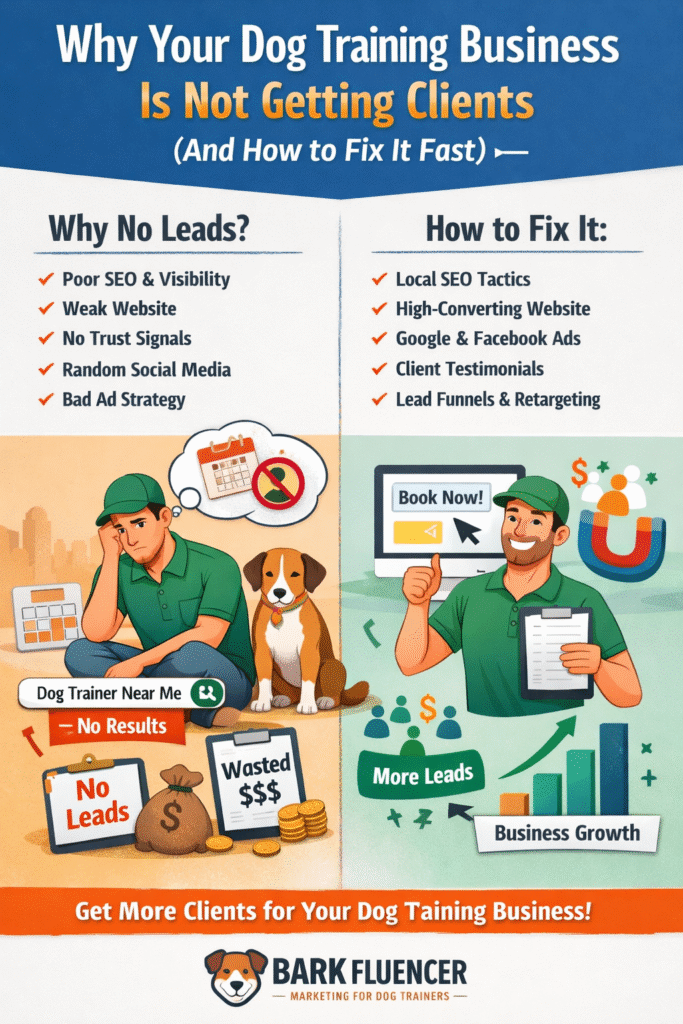
If your dog training business is not getting clients consistently, the issue is rarely your expertise. Most dog trainers deliver great results – but struggle to generate predictable leads.
The real problem is visibility, positioning, and conversion systems.
This guide explains:
- Why dog trainers fail to attract consistent inquiries
- The most common dog trainer marketing problems
- A practical system to increase dog training leads quickly
Why Dog Training Businesses Struggle to Get Clients
Most dog trainers rely on inconsistent channels:
- Word-of-mouth referrals
- Occasional social media posts
- One-time promotions
These methods are unpredictable and difficult to scale.
A sustainable business requires:
- Consistent traffic
- Qualified leads
- A clear conversion path
Without these, even experienced trainers face empty schedules.
The Core Problem – No Lead Generation System
If your dog training business is not getting clients, it usually comes down to one issue:
There is no structured system to attract, nurture, and convert potential customers.
This leads to:
- Low visibility in search results
- Missed opportunities from interested visitors
- Poor conversion rates
Top Dog Trainer Marketing Problems That Limit Growth
1. Lack of Local Search Visibility
Dog training is a location-based service. Most clients search using intent-driven queries such as:
- dog trainer near me
- puppy training in [city]
If your business does not appear in local search results, you are losing high-intent leads daily.
What’s Missing:
- Google Business Profile optimization
- Location-based landing pages
- Local keyword targeting
2. Website That Fails to Convert Visitors
A website should function as a conversion tool, not just an online brochure.
Common issues include:
- No clear call-to-action
- Weak messaging
- No service differentiation
- Poor mobile experience
If visitors cannot quickly understand your value and next step, they leave.
3. Weak Positioning and Generic Messaging
Many dog trainers describe their services in similar ways:
- “Professional dog training services”
- “Experienced trainer”
This does not differentiate you.
Clients are looking for solutions, not descriptions.
Examples of stronger positioning:
- Fix aggressive dog behavior
- Stop excessive barking
- Puppy obedience training in 30 days
4. Lack of Trust Signals
Dog owners are cautious when choosing a trainer. They want proof before making contact.
Missing trust elements:
- Verified reviews
- Case studies
- Before-and-after transformations
- Clear process explanation
Without trust, visitors hesitate to convert.
5. Ineffective or Unstructured Advertising
Running ads without strategy often results in wasted budget.
Common mistakes:
- Broad targeting
- No keyword intent alignment
- Sending traffic to generic pages
- No follow-up or retargeting
Effective advertising requires alignment between search intent, messaging, and landing page experience.
How to Increase Dog Training Leads (Actionable Framework)
1. Build a Conversion-Focused Funnel
A high-performing system includes:
- A dedicated landing page
- A clear offer (consultation, assessment, or program)
- A strong call-to-action
The goal is to reduce friction and guide users toward booking.
2. Implement Local SEO Strategy
Local SEO is one of the most reliable sources of consistent leads.
Key actions:
- Optimize Google Business Profile
- Create city-specific service pages
- Use keywords such as:
- dog training in [city]
- puppy trainer near me
This captures users with immediate intent.
3. Use High-Intent Paid Advertising
Search-based advertising (such as Google Ads) targets users actively looking for services.
Advantages:
- Immediate visibility
- High conversion potential
- Measurable ROI
Focus on:
- Exact match intent keywords
- Location targeting
- Dedicated landing pages
4. Publish Problem-Solution Content
Content marketing builds authority and attracts organic traffic.
Focus on topics like:
- how to stop dog barking
- how to train a stubborn dog
- puppy training mistakes
This aligns with real search behavior and builds trust before contact.
5. Use Retargeting to Capture Missed Leads
Most users do not convert on the first visit.
Retargeting helps you reconnect with:
- Website visitors
- Ad clickers
- Social media viewers
This increases overall conversion rates without increasing traffic cost.
Key Indicators That Your Marketing Needs Fixing
If you notice the following, your system needs improvement:
- Low website inquiries
- Traffic without conversions
- No presence in local search results
- Inconsistent monthly bookings
These are not isolated issues – they indicate structural gaps in your marketing.
Building a Sustainable Lead Generation System
To consistently increase dog training leads, your business needs:
- Visibility (SEO + ads)
- Trust (reviews, proof, authority)
- Conversion system (landing pages + CTA)
- Follow-up (retargeting and nurturing)
When these components work together, lead flow becomes predictable.
Conclusion
If your dog training business is not getting clients, the issue is not demand – it is structure.
Dog owners are actively searching for training services every day. The businesses that capture these leads are the ones with:
- Clear positioning
- Strong visibility
- Conversion-focused systems
Fixing these areas does not require guesswork. It requires a strategic approach aligned with how people search, evaluate, and decide.
At Bark Fluencer, we help dog trainers turn their expertise into a steady flow of clients. Ready to grow your business? Get in touch with our team today.