There are two types of dog trainers running Facebook ads in 2026.
The first type boosts a post, gets a handful of likes, spends $150, and walks away thinking Facebook ads don’t work. The second type runs a deliberately structured campaign, fills two group class spots in a week, and books a board and train inquiry – all from a $7/day budget.
Same platform. Completely different results.
The difference isn’t budget. It isn’t even the quality of the training. It’s whether the trainer understands how Meta’s ad system actually works for a local service business – and builds their campaign around that understanding.
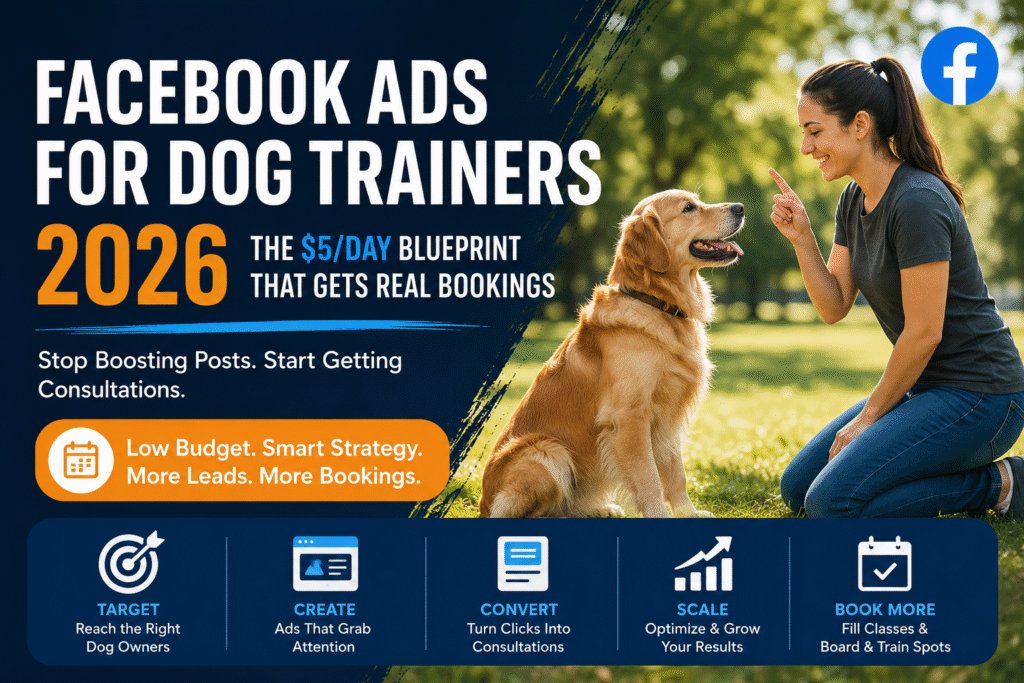
This guide gives dog trainers the exact framework. Targeting, creative, copy, budget, and the step-by-step setup that generates real consultation bookings – not just impressions.
Why Facebook Ads Work Differently for Dog Trainers Than for Other Businesses
Most Facebook advertising advice is written for e-commerce brands or national service companies. Dog training is neither.
You serve a specific geography. Your ideal client owns a dog with a specific problem. And you need that person to trust you enough to hand over their dog – or let you into their home. That trust requirement changes everything about how your ads need to work.
The good news: 78% of dog owners use social media to research pet services before booking, and 54% discover new pet businesses through social platforms. Your potential clients are already on Facebook and Instagram every day. They’re scrolling past content about their dogs constantly. The question is whether your ad stops them – and whether what comes after it converts them.
Facebook ads for dog trainers work best not as a direct “buy now” mechanism, but as a trust-building and lead-capture tool. Your ad starts a conversation. Your follow-up closes it.
The $5/Day Strategy: How It Actually Works
The $5/day approach isn’t about spending as little as possible. It’s about learning as cheaply as possible before you scale.
Here’s the core logic:
When you launch a new Facebook ad, Meta’s algorithm spends the first 5–7 days in a “learning phase” – testing different audiences, placements, and times of day to find the people most likely to take your desired action. During this phase, results are inconsistent and costs are higher. You need roughly 50 conversions before the algorithm exits learning and optimizes efficiently.
Starting with a daily budget of $10–$20 per ad set provides enough delivery to generate initial results without major financial risk. Run this budget for at least 5 to 7 days before making optimization decisions.
For dog trainers just starting out, $5–$10/day is enough to gather data, identify what messaging resonates, and avoid burning budget on an unproven approach. Once you find an ad that generates inquiries, you scale it. You’re not trying to reach everyone – you’re trying to find the message that works, then amplify it.
The $5/day starting framework:
- Day 1–7: Run 2–3 ad variations at $5/day each, testing different hooks
- Day 8–14: Kill the lowest-performing ad, put that $5 behind the winner
- Day 15+: Scale the winning ad to $15–$25/day and watch lead volume increase
This is how you go from spending $150 with no results to spending $150 with 4–6 real consultation inquiries.
The Foundation: What You Need Before You Run a Single Ad
Running ads without these in place is like driving with the handbrake on.
1. A Meta Business Manager account Set up at business.facebook.com. This is where you manage your ad account, pages, and pixel – all separate from your personal profile.
2. Meta Pixel installed on your website The Pixel is a small piece of code that tracks what visitors do on your site after clicking your ad. It tells you which ads are driving actual bookings vs. just clicks – and it enables retargeting (showing ads to people who visited your site but didn’t book). This is non-negotiable for running efficient campaigns.
3. A dedicated landing page – not your homepage Every ad needs to point to a specific page built around a single action: book a consultation, sign up for a free guide, or register for a class. Sending ad traffic to your homepage kills conversions. A focused landing page with one CTA can double or triple your conversion rate from the same ad spend.
4. A lead response system The biggest waste in dog trainer advertising is a lead that goes cold because nobody followed up fast enough. Have a system – even a simple text message or email auto-responder – that contacts every inquiry within 15 minutes of submission. Response speed is the single biggest variable in lead-to-booking conversion.
Targeting: How to Reach Dog Owners Who Are Ready to Hire
Facebook’s targeting capabilities are what make it genuinely powerful for local service businesses. You’re not broadcasting to everyone – you’re reaching a specific person at a specific moment.
Geographic Targeting
Start with a radius around your service area – typically 10–20 miles for most dog trainers. If you do in-home sessions, this radius should match your realistic travel limit. For facility-based trainers, keep it tighter (5–10 miles) because people rarely drive more than 20 minutes for regular training sessions.
Demographic Targeting
Dog training clients skew toward:
- Ages 25–55 (peak dog ownership years and disposable income)
- Homeowners (more likely to have dogs, more invested in training)
- Parents with young children (often seeking calmer, safer dogs at home)
- Higher household income brackets in urban/suburban markets
Interest and Behavior Targeting
This is where Facebook’s depth becomes a real advantage for dog trainers:
- Pet interests: Dog owners, specific breed communities, pet supply shoppers
- Life events: Recently moved (new neighborhood = new routines), recently had a baby (common trigger for training urgency), new pet owner
- Behaviors: People who’ve engaged with pet-related content, visited pet store websites, or liked dog training pages
- Purchase behaviors: Pet supply buyers, subscription box subscribers
The Most Powerful Targeting Option: Custom and Lookalike Audiences
Custom audiences allow you to target existing clients or leads. Lookalike audiences help you reach users with similar characteristics to your existing audience – both provide powerful ways to expand your reach and attract new clients.
Once you have 100+ email addresses from past clients, you can upload them to Meta, create a custom audience, and then build a lookalike audience – Facebook finds people in your area who share characteristics with your best clients. This is the targeting tier that the most successful dog trainer campaigns run on.
Ad Creative: What Stops the Scroll in 2026
Social media ads must stop the scroll within 1–2 seconds. Use bold, contrasting visuals, faces – human or canine – creating eye contact, movement or video over static images, and text overlays highlighting compelling hooks.
For dog trainers specifically, here’s what performs best:
Video Ads (Highest Performing Format)
Before-and-after transformation videos are the single most effective ad format for dog trainers. Show a reactive dog lunging at strangers in the first 3 seconds – then the same dog walking calmly past a crowded park. No voiceover needed. The visual does all the work.
Keep video ads 15–30 seconds. Hook in the first 2 seconds. Show the transformation. End with a clear CTA on screen.
What to capture for strong video ads:
- A dog arriving stressed vs. leaving calm after a session
- A before/after leash walk clip
- A dog ignoring recall commands vs. coming immediately
- A real client talking for 20 seconds about what changed
Static Image Ads (Fast to Test)
Use high-contrast images with a dog and trainer in frame. Human-canine eye contact with the camera performs consistently well. Add a short text overlay – no more than 5 words – that speaks to the dog owner’s pain point: “Still pulling on every walk?” or “New puppy keeping you up?”
Carousel Ads (Great for Group Classes)
Carousel ads show multiple images or videos in a swipeable format. For dog trainers, use them to showcase different services (puppy class, private sessions, board and train), different transformation stories, or the step-by-step journey of a training program.
Ad Copy: The Framework That Books Consultations
Your ad copy follows a simple 5-part structure. Each element has a specific job.
Part 1 – The Hook (Line 1) Speaks directly to a pain point your ideal client feels right now. Examples:
- “Is your dog embarrassing you on every walk?”
- “New puppy destroying your house? You’re not alone.”
- “Most reactive dogs aren’t aggressive – they’re just undertrained.”
Part 2 – Empathy (1–2 sentences) Show you understand the frustration before you offer a solution. Dog owners feel judged about their dog’s behavior. Acknowledge it. “Most dog owners try everything – YouTube videos, treats, raised voices – and still feel like they’re failing.”
Part 3 – The Shift (1–2 sentences) Introduce yourself and your credibility in one breath. Not your certifications – your results. “I’ve helped 200+ dog owners in [City] turn frustrated, reactive dogs into calm companions – usually within 4–6 weeks.”
Part 4 – The Offer (1 sentence) A single, low-friction next step. A free consultation is the gold standard for dog trainers because it removes the commitment barrier. “Book a free 20-minute call and I’ll tell you exactly what your dog needs.”
Part 5 – The CTA (1 sentence) Direct, specific, urgent. “Click below to grab one of this week’s 3 open consultation spots.”
Full example ad:
“Does your dog bark, lunge, or pull every time another dog walks by?
Most reactive dogs aren’t dangerous – they’re just overwhelmed. And most owners have tried everything without seeing real change.
I’m [Name], and I’ve helped dog owners across [City] rebuild calm, confident dogs using a method that works even for the most reactive cases – without punishment, without prong collars, without giving up.
Right now I’m offering a free 20-minute strategy call where I’ll identify exactly what’s triggering your dog and give you a clear first step.
3 spots open this week. Click to book yours.”
Campaign Structure: The Right Objective for Dog Trainers
Meta Ads Manager asks you to choose a campaign objective before you build anything. Choosing wrong wastes money. Here’s the right choice for each goal:
| Goal | Campaign Objective |
|---|---|
| Fill group class spots | Leads (Meta lead form) |
| Book free consultations | Leads or Traffic (to landing page) |
| Get DMs and inquiries | Messages |
| Retarget website visitors | Conversions (requires Pixel) |
| Build brand awareness locally | Awareness (use sparingly) |
For most dog trainers starting out, Leads with Meta’s native lead form is the easiest starting point. The form pre-fills the prospect’s name, email, and phone number from their Facebook profile – reducing friction to near zero. You get the lead instantly, follow up immediately.
As you scale and gather Pixel data, shift to Conversions targeting – it’s more expensive per lead but produces higher-quality inquiries because the prospect has visited your website and shown deeper intent.
Budget Strategy: From $5/Day to $50/Day
Month 1 – Testing phase ($5–$10/day) Run 3 ad variations targeting the same audience with different hooks. Total spend: $150–$300. Goal: identify which creative and copy angle generates the most inquiries. Don’t judge results in the first 5 days.
Month 2 – Optimization phase ($15–$25/day) Kill the two weakest ads. Put full budget behind the winner. Introduce one new creative test per week. Total spend: $450–$750. Goal: consistent lead flow of 5–10 inquiries/month.
Month 3+ – Scaling phase ($30–$50/day) Once you have a proven ad that converts at an acceptable cost per lead, scale the budget 20% per week – not all at once. Rapid budget increases reset the learning phase. Total spend: $900–$1,500/month. Expected result: 15–30 qualified leads per month.
Understanding ROI for dog training ads: If you close 30% of consultations and your average client value is $600 (6 sessions × $100), each booking is worth $600. At $50/lead and a 30% close rate, you’re paying $167 per client. On a $600 service that’s a 3.6x return – before repeat bookings, referrals, and upsells.
Maintain a 3–5x return on ad spend as the minimum threshold. If your numbers aren’t hitting that, the problem is usually the landing page or follow-up speed – not the ads themselves.
The 3 Biggest Mistakes Dog Trainers Make With Facebook Ads
Mistake 1: Boosting posts instead of running proper campaigns Boosted posts reach people who already like your page. Proper campaigns reach new dog owners in your area who’ve never heard of you. Boosting feels like advertising – it produces engagement metrics, not leads.
Mistake 2: Sending ad traffic to the homepage Your homepage is designed for exploration. Ad traffic needs a single focus – one offer, one CTA, one path. A dedicated landing page consistently outperforms a homepage by 2–4x for consultation bookings.
Mistake 3: Giving up after one week You need approximately 50 leads to determine if an ad truly works. The personal trainers successfully scaling their businesses with ads have typically spent months learning what works for their specific niche and location. Your first ad probably won’t be your best – treat it as a learning opportunity and iterate based on data.
Facebook Ads vs. Google Ads for Dog Trainers: Which to Run First?
This comes up constantly, so let’s settle it clearly.
Google Ads capture people who are actively searching for a dog trainer right now. High intent, ready to book. More expensive per click but faster path to a paying client.
Facebook Ads reach people who aren’t searching yet but fit the profile of someone who will. Lower cost per lead, requires more trust-building, slightly longer path to booking.
For most dog trainers, the right answer is both – but in sequence. Start with Google Ads if your calendar is empty and you need leads immediately. Add Facebook Ads once you have a baseline of client flow and want to build awareness, fill group classes, and generate a consistent pipeline at a lower cost per lead.
The combination of Google Ads (capturing active demand) and Facebook Ads (creating demand) is the most consistent lead generation system in the dog training industry in 2026.
Meanwhile, SEO for dog trainers builds the long-term organic foundation that eventually reduces your dependence on paid ads entirely.
Frequently Asked Questions
Do Facebook ads actually work for dog trainers? Yes – when set up correctly. The key difference between ads that work and ads that don’t is targeting precision, creative quality, and what happens after someone clicks. Dog trainers who combine strong local targeting, a pain-point-driven hook, and a fast follow-up system consistently generate consultation bookings from Facebook ads at a profitable cost per lead.
How much should a dog trainer spend on Facebook ads per month? Start with $150–$300/month during the testing phase. Once you identify a winning ad, scale to $450–$750/month for consistent lead flow. Trainers running mature, optimized campaigns typically spend $500–$1,500/month and generate 15–40 leads per month depending on their market and offer.
What type of Facebook ad works best for dog trainers? Video ads showing real dog transformations – reactive to calm, pulling to loose leash – consistently outperform static images for dog trainers. They prove results visually without requiring the viewer to read anything. A 15–30 second before-and-after clip with a simple CTA at the end is the highest-converting format for most dog training ads in 2026.
Should I run Facebook ads or focus on organic social media? Both serve different purposes. Organic social builds trust and community with people who already know you. Facebook ads reach new dog owners who’ve never heard of you and put your business in front of them at scale. For consistent lead generation, paid ads are essential – organic social alone cannot reliably fill a training calendar in most markets.
How do I target dog owners on Facebook? Use a combination of geographic targeting (10–20 mile radius), demographic targeting (ages 25–55, homeowners), and interest/behavior targeting (pet owners, specific breed communities, recent pet adoption life events). The most effective targeting for established dog training businesses is a lookalike audience built from your existing client email list – Meta finds new local users who share characteristics with your best current clients.
Can I run Facebook ads with no marketing experience? Yes, but expect a learning curve of 1–3 months before your campaigns become consistently profitable. The most common beginner mistake is making too many changes too quickly – edit one element at a time (copy, image, or audience) so you know what actually caused a change in results. If you want results faster without the trial and error, working with a specialist in Facebook and Instagram ads for dog trainers shortens that curve significantly.
Ready to Fill Your Calendar With Facebook Ads?
You now have the full framework – targeting, creative, copy, budget, and the common pitfalls to avoid.
The trainers who get results from Facebook ads aren’t spending more than everyone else. They’re spending smarter – testing deliberately, following up fast, and building on what works.
At Bark Fluencer, we manage Facebook and Instagram ad campaigns exclusively for dog trainers across the US. We handle creative, copy, targeting, optimization, and reporting – so you can focus on training dogs while we fill your calendar.
Book your free strategy call today →
We’ll audit your current online presence, show you exactly what a profitable dog training ad campaign looks like in your market, and give you a clear plan – no obligation, no fluff.
Published by Bark Fluencer – the digital marketing agency built exclusively for dog trainers and pet professionals across the US.