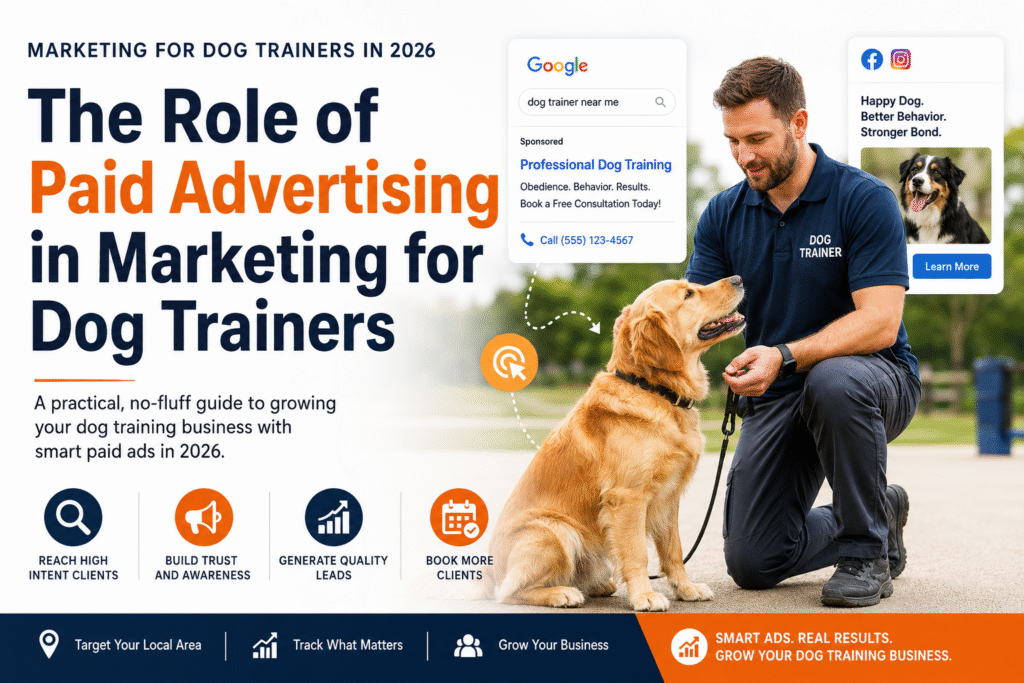
A practical, no-fluff guide to growing your dog training business with smart paid ads in 2026
Let me ask you something honest: how are clients finding you right now?
If your answer is mostly “word of mouth” or “hoping someone stumbles onto my website,” you’re not alone. Most dog trainers I talk to are incredible at what they do — and completely invisible online. And in 2026, that invisibility is costing you real money.
This isn’t a post about following trends for the sake of it. It’s about one simple truth: paid advertising, done right, is the fastest way to go from a half-empty schedule to a fully booked calendar. No waiting months for SEO to kick in. No algorithm hoping. You put your name in front of people who are actively looking for a dog trainer — right now, in your area — and they call you.
This guide breaks down exactly how paid ads can grow your dog training business.
Why Paid Ads Have Become Non-Negotiable for Dog Trainers in 2026
The pet industry crossed $180 billion globally in 2026, and demand for professional dog training is at an all-time high. The pandemic-era puppy boom gave millions of families their first dog. Many of those dogs are now 3–5 years old and struggling with issues their owners never addressed — leash reactivity, separation anxiety, jumping on guests, resource guarding. That’s your market. It’s enormous.
But here’s the challenge: organic reach is declining. Google has made it harder for small local businesses to rank without some paid presence. Social media feeds are noisier than ever. The dog trainers who are thriving aren’t just better at training — they’re better at being found.
According to recent pet industry data, 78% of dog owners search online before booking a trainer. That search is your opportunity. And paid ads are what ensure your name shows up when it matters most.
Quick Stats for 2026:
78% of dog owners search online before booking a trainer
Average ROI on local Google Ads for service businesses: 4.2x
62% of dog owners will pay a premium for certified trainers
$180B — the global pet industry market size this year
Which Ad Platforms Actually Work for Dog Trainers?
Not all platforms are equal. Here’s a straight-talking breakdown of where your advertising budget will work hardest:
Google Search Ads — Best for Immediate Bookings
When someone types “dog trainer near me” or “puppy obedience classes in [your city],” they’re not browsing — they’re ready to act. Google Search Ads put you at the top of those results instantly. This is the highest-intent audience you’ll ever reach, and for most dog trainers, it delivers the fastest return. Start here.
Meta Ads (Facebook & Instagram) — Best for Trust-Building
Meta’s strength is visual storytelling. A well-edited 30-second video of a reactive dog calming down stops the scroll. Before-and-after reels build more trust than any written testimonial could. Meta doesn’t capture demand the way Google does, but it creates it — which is why the two work so well together.
YouTube Ads — Best for Education-Led Selling
Dog training content is massively popular on YouTube. Running a short pre-roll ad before a popular training video puts your name in front of someone who is already in the mindset. It’s an underused channel for local trainers, which means less competition and lower costs.
TikTok Ads — Best for Reaching Younger Pet Owners
If you’re not on TikTok yet, consider this your nudge. Pet owners aged 24–38 are highly active here, and native-feeling training tip videos can drive massive engagement at lower cost than other platforms. Short-form is the format of 2026.
How to Build a Paid Ad Strategy That Actually Gets You Clients
Running ads without a strategy is like training a dog without consistency — you’ll go in circles and wonder why nothing sticks. Here’s how to approach it properly.
Start Hyper-Local
Most dog trainers work within a 20–30 mile radius. Use Google’s location targeting and Meta’s radius settings to make sure every dollar you spend reaches people who can actually book with you. In 2026, AI-powered geo-targeting can even prioritize neighborhoods with higher dog ownership — use it.
Lead With the Problem, Not Your Credentials
Your potential clients don’t open Google thinking, “I need someone with a CPDT-KA certification.” They open Google thinking, “My dog is destroying my house and I don’t know what to do.” Your ad copy should meet them there. Lead with the pain point, then offer the solution.
Instead of: “Professional dog trainer with 10 years of experience”
Try: “Is your dog pulling so hard that walks feel like a battle? We fix that in 4 sessions — guaranteed.”
Feel the difference? One is about you. The other is about them.
Use Video — It’s Not Optional Anymore
There is no better ad format for a dog trainer than video. A short clip of a reactive dog going from chaos to calm is worth more than any headline you could write. Get client permission, film your training sessions, capture the before-and-after. Even a phone-filmed video that’s authentic outperforms polished stock imagery every single time.
Build a Simple Retargeting Funnel
Most people won’t book on the first visit to your website — and that’s normal. Set up a retargeting campaign: someone visits your site, then they see your ad again on Facebook showing a testimonial. Then they see it one more time on Google. This multi-touch approach dramatically lifts conversion rates at a much lower cost than chasing cold audiences repeatedly.
Create a Dedicated Landing Page
Never send ad traffic to your homepage. Create a simple, focused landing page for each campaign that matches the ad message exactly. Someone who clicked “reactive dog training” should land on a page that says “reactive dog training” — not your general services overview. This single change can double your conversion rate.
Practical Tips Before You Spend a Single Dollar
- ✅ Set a minimum of $300–$500/month to gather meaningful data
- ✅ Track phone calls and form submissions — not just clicks or impressions
- ✅ Use negative keywords in Google Ads to block irrelevant searches (e.g., “free dog training,” “dog training videos”)
- ✅ A/B test your ad headlines every 30 days — small wording changes can double click-through rates
- ✅ Collect email addresses via lead ads and follow up with a simple welcome sequence
- ✅ Make sure your website loads fast on mobile — if it takes more than 3 seconds, fix that first
AI Advertising Tools in 2026: What’s Actually Changed
This year, AI has genuinely transformed how local service ads work — and for dog trainers, that’s a good thing.
Google’s Performance Max campaigns now automatically optimize your ads across Search, Display, YouTube, and Maps simultaneously. Meta’s Advantage+ targeting removes a lot of the audience-building guesswork, letting the algorithm find your ideal clients based on behavior signals rather than demographics you’ve manually selected.
But here’s the thing people get wrong: AI ad tools amplify your strategy — they don’t replace it. You still need compelling creative. You still need copy that speaks to real problems. You still need conversion tracking set up correctly. Think of these tools as a highly efficient assistant, not a magic button.
Dog trainers who combine a strong brand message with AI-assisted optimization are seeing 3x better results than those using manual targeting alone. Invest in good creative first. The algorithm rewards it.
The 3 Most Common Paid Ad Mistakes Dog Trainers Make
Mistake 1: Sending traffic to a slow website. More than half of ad clicks happen on mobile devices. If your site takes more than 3 seconds to load, you’re losing clients before they even read your headline. A fast, mobile-optimized landing page isn’t optional — it’s the foundation everything else rests on. Fix this before you spend anything on ads.
Mistake 2: Not tracking conversions. If you don’t know which ad led to a booking, you can’t make smart decisions about where to put your budget. Set up conversion tracking from day one — tracking phone calls, form fills, and booking confirmations. Most platforms have simple setup guides, or you can hire a freelancer for a one-time configuration.
Mistake 3: Quitting too early. Paid ads almost always take 60–90 days to fully optimize. The algorithm needs data. You need time to test different messages. Dog trainers who quit after 30 days never get to see the compound results that come from a well-optimized campaign. Commit to a 90-day trial before drawing any conclusions.
Frequently Asked Questions About Paid Advertising for Dog Trainers
How much should a dog trainer spend on paid ads per month?
For most local dog trainers, starting with $1000–$2000 per month on Google Search Ads is the sweet spot. This gives you enough data to test your messaging and see real results without overextending your budget. As you identify what’s working, scale up confidently from there.
Is Google Ads or Facebook Ads better for dog trainers?
Both serve different purposes. Google Ads drives faster bookings because you’re reaching people who are actively searching for a trainer right now. Facebook and Instagram are better for building awareness and social proof. Ideally, use both: Google to capture demand, Meta to nurture trust.
Can I run paid ads myself or do I need a marketing agency?
Yes, you can absolutely manage your own campaigns — especially with Google’s Smart Campaigns and Meta’s Advantage+ products, which simplify a lot of the technical setup. However, if you’re spending more than $500/month, working with a specialist who understands local service businesses can significantly improve your return on investment.
What makes a good paid ad for a dog training business?
The best dog trainer ads do four things well: they speak to a specific problem (leash pulling, aggression, anxiety), show real results through video or client photos, include a clear and low-friction call to action like “Book a Free Consult,” and feature genuine social proof — real names, real outcomes, real locations.
How long does it take for paid ads to work for a dog training business?
Give it 60–90 days before judging the results. The first 30 days are data collection. Days 30–60 are optimization. By day 90, you’ll have a clear picture of your cost-per-lead and which campaigns are worth scaling. Most trainers who give up do so just before things start to click.
The Bottom Line
Paid advertising in 2026 isn’t about throwing money at the internet and hoping something sticks. It’s a deliberate, data-driven investment that — done right — fills your calendar, grows your local reputation, and gives you the freedom to run your business on your own terms.
You got into dog training because you love dogs and you love helping people. Every great trainer knows that consistent, patient effort produces the best results. Your marketing works the same way.
Start with a focused $1000/month Google Search campaign in your local area. Track everything. Optimize based on what you learn. And remember: the dog owners in your city who need you most just need to be able to find you first.
That’s what paid advertising does. Let it work for you.
At Bark Fluencer, we manage Google ads, Facebook and Instagram ad campaigns exclusively for dog trainers. We handle creative, copy, targeting, optimization, and reporting – so you can focus on training dogs while we fill your calendar.
Book your free strategy call today →
We’ll audit your current online presence, show you exactly what a profitable dog training ad campaign looks like in your market, and give you a clear plan – no obligation, no fluff.
Published by Bark Fluencer – the digital marketing agency built exclusively for dog trainers and pet professionals across the US.