
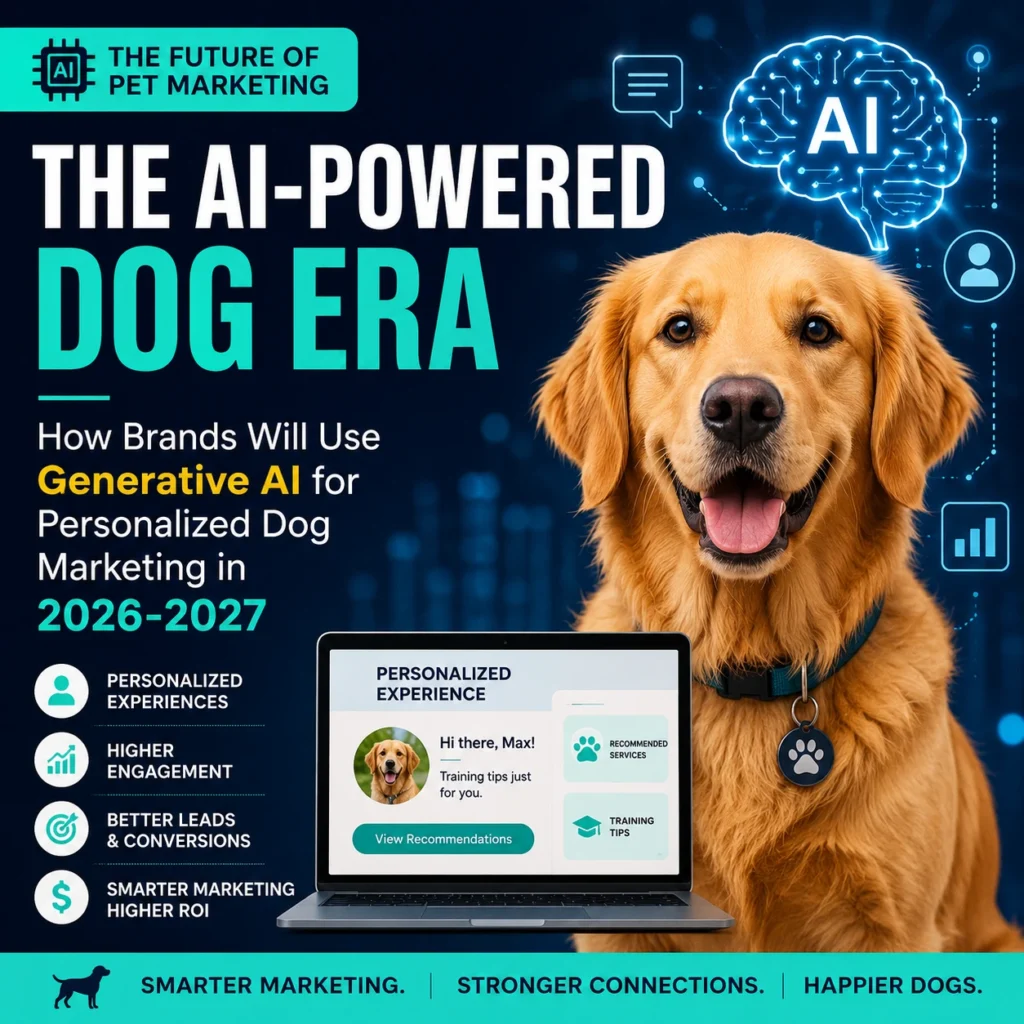
The Convergence of AI and Dog Marketing
The dog services industry is experiencing a transformation. Generative AI technology that barely existed three years ago is now reshaping how pet brands market to dog owners. This transformation accelerates in 2026 and 2027 as AI capabilities mature and adoption spreads.
According to McKinsey’s 2026 AI adoption report, 62 percent of companies now use generative AI in marketing operations, up from 18 percent in 2023. In the pet industry specifically, adoption accelerates faster. Dog trainers, pet product companies, veterinary clinics, and pet service businesses are discovering that AI-powered personalization increases customer engagement by 40-60 percent and conversion rates by 25-35 percent.
This article explores how generative AI transforms dog marketing. Not through theoretical discussion but through specific use cases, concrete implementation tactics, and measurable results that dog service providers and pet brands are achieving now and will scale in 2026-2027.
The future of dog marketing isn’t about broad targeting or generic messaging. It’s about personalized experiences powered by AI that speak directly to each dog owner’s specific needs, preferences, and pain points. The brands embracing this shift in 2026-2027 will dominate their markets. Those clinging to traditional marketing tactics will become obsolete.
How Generative AI Transforms Dog Marketing Today
The Convergence of AI and Dog Marketing
Generative AI systems like GPT-4, Claude, and specialized pet industry AI tools now perform marketing tasks that previously required human copywriters, designers, and analysts.
Content generation reaches human-quality level. An AI system can write a blog post about puppy training that ranks on Google, reads naturally, and answers searcher questions comprehensively. A dog trainer can prompt the system: “Write a 1,500-word blog post about stopping puppy jumping targeted at first-time dog owners, optimized for the keyword phrase ‘how to stop puppy jumping,’ include three case studies.” The system produces a complete article in minutes.
Personalized email campaigns can now be created at scale. Rather than one generic email sent to your entire email list, AI systems analyze each subscriber’s behavior, preferences, and engagement history to customize the message. Someone who clicked on puppy training emails receives different messaging than someone interested in aggressive dog behavior modification.
Predictive customer behavior analysis identifies which prospects convert to clients. By analyzing past customer data, AI identifies patterns. Customers who watched three specific YouTube videos were 3.5 times more likely to book consultations. Customers who opened emails about aggression were 2x more likely to purchase board and train programs. These insights drive smarter marketing targeting.
Content personalization across channels happens automatically. A prospect visiting your website sees different content based on their previous interactions. If they visited your aggressive dog training page three times, the homepage highlights aggressive dog specialization. If they viewed board and train content, promotions for board and train appear prominently.
Customer sentiment analysis from reviews and social media reveals what dog owners care about most. AI systems analyze 500 customer reviews and identify that 34 percent mention “patience and kindness,” 28 percent mention “visible results,” and 24 percent mention “personalized approach.” Your marketing messaging now emphasizes what customers actually value.
Current Real-World Results
Dog training businesses and pet service companies implementing AI-powered personalization report specific, measurable improvements.
Email marketing performance improves significantly. A dog training business with a 1,000-subscriber email list using generic emails achieves 20-25 percent open rate and 2-3 percent click-through rate. Switching to AI-personalized emails increases open rates to 35-40 percent and click-through rates to 6-8 percent. Same list size, same email frequency, dramatically improved engagement.
Cost per lead through paid advertising decreases 30-40 percent. AI systems optimizing Google Ads and Facebook Ads in real-time (adjusting bids, targeting, and creative based on performance data) generate leads at lower cost than human optimization. A dog trainer spending 1,000 dollars monthly on ads and generating 5 leads at 200 dollar cost per lead switches to AI-optimized campaigns and generates 8 leads at 125 dollar cost per lead on the same budget.
Website conversion rates improve 25-35 percent. AI-powered landing page optimization tests different headlines, images, and copy combinations automatically. Rather than human marketing managers testing one variation per month, AI systems test dozens of variations daily. Winners get more traffic automatically. Losers get eliminated.
Content creation productivity increases 3-5 times. A copywriter previously spending 4 hours writing one blog post now spends 1 hour reviewing and editing AI-generated content. Five blog posts weekly becomes achievable for solo trainers.
Part 2: The AI-Powered Dog Marketing Landscape in 2026-2027
Personalization at Scale Becomes Standard
By 2026-2027, AI-powered personalization shifts from competitive advantage to industry standard. Dog service companies without personalized customer experiences compete at disadvantage.
Website personalization becomes default. A prospect visits a dog trainer’s website and immediately sees content matching their specific situation. New puppy owner sees puppy training content and testimonials from other puppy owners. Owner with aggressive dog sees aggressive dog content and case studies specific to aggression. Same website, completely different experience for each visitor.
Implementation: AI systems track visitor behavior, past interactions, and inferred needs. Using this data, they dynamically adjust page content, offers, and calls to action in real-time. No human intervention required.
Email personalization extends beyond name substitution. AI systems analyze each subscriber’s past behavior, engagement patterns, and expressed interests. They craft emails that speak to that individual’s specific situation. Frequency, timing, and content adapt to each person’s optimal engagement pattern.
Implementation: Email platforms integrate with AI systems that predict optimal send times for each subscriber (studying when they typically open emails), customize subject lines based on what drives opens for that specific person, and personalize email content based on their interests and past interactions.
SMS and push notification personalization reaches maturity. Dog owners receive text messages and push notifications about training tips, appointment reminders, or promotions that speak specifically to their dog and their situation. A dog owner with a reactive dog receives reactive dog training tips. A dog owner with a puppy receives puppy socialization reminders.
Implementation: Mobile apps and SMS platforms integrate with AI systems that determine optimal notification timing and content for each user.
AI-Generated Content at Scale
By 2026-2027, generative AI produces majority of marketing content for mid-size and larger pet service companies.
Personalized video content: AI systems now generate short videos personalized to individual prospects. A prospect with a jumping puppy receives a video about stopping puppy jumping. A prospect with an anxious dog receives anxiety-specific training content. Not generic videos. Videos that speak directly to their situation.
Implementation: AI video generation tools create videos by combining pre-recorded trainer footage with AI-generated voiceover and editing. Speed increases from weeks per video to hours per video.
Automated blog post generation: Rather than hiring copywriters to write blog posts, pet service companies use AI to generate content that’s automatically optimized for search engines and reader engagement. Five to ten blog posts per week becomes standard for growing businesses.
Implementation: AI systems generate long-form content at scale, optimizing for keyword targeting, readability, and conversion.
Social media content at scale: AI systems generate social media posts (Instagram, TikTok, Facebook) that are optimized for each platform and audience segment. Instead of generic content, different content reaches different audience segments.
Implementation: AI systems generate 10-20 social media variations daily, targeting different audience segments with messages relevant to their specific interests and pain points.
Personalized sales pages: Rather than one sales page for “dog training services,” pet companies have AI generate customized landing pages for each traffic source and audience segment. Google Ad traffic sees one page. Referral traffic sees another. Email subscribers see a third.
Implementation: AI systems analyze traffic source and visitor characteristics, then dynamically generate landing page copy optimized for conversion from that specific source.
Part 3: Specific Use Cases for Dog Training Businesses
Use Case 1: AI-Powered Lead Scoring and Prioritization
Dog training businesses receive multiple types of leads. Some are highly qualified. Some are window shopping. Some are price shopping. Without proper prioritization, trainers waste time on low-quality leads.
In 2026-2027, AI systems automatically score leads based on conversion likelihood.
How it works: A prospect submits an inquiry form. The AI system analyzes their responses against historical data of past clients. It calculates conversion probability based on factors like:
Dog age (puppies convert at different rate than adult dogs)
Specific behavioral issue (aggressive dog leads convert at higher rate than jumping dog leads)
Budget mention (prospects mentioning budget constraints have higher closing rates than price-blind prospects)
Urgency signals (mentioning timeline and immediate need increases conversion probability)
Previous interactions (if prospect watched five training videos before inquiring, higher conversion probability than first visit inquiry)
The system assigns a score: 95 percent conversion probability, 65 percent conversion probability, 35 percent conversion probability. Trainers prioritize highest-probability leads first.
Result: In a typical week, a trainer might receive 15 inquiries. Without AI scoring, they contact all 15. Using AI scoring, they identify that five leads have 80+ percent conversion probability, six leads have 50-70 percent probability, and four leads have under 40 percent probability. They focus on top five leads first, knowing those are most likely to convert.
Measured result: Trainers report 40-50 percent increase in booking rate by focusing on high-probability leads.
Use Case 2: Dynamic Pricing and Offer Personalization
In 2026-2027, pricing and promotional offers personalize based on each customer’s situation and likelihood to purchase.
How it works: An AI system analyzes a prospect’s background, previous interactions, and expressed needs. Based on this analysis, it recommends optimal pricing and offers:
A budget-conscious new puppy owner sees “Five-Session Puppy Starter Package” promotion.
A dog owner with urgent behavioral issues sees “Same-Day Assessment” offer.
A price-insensitive client with significant behavioral concerns sees premium “Intensive Board and Train Program.”
A prospect who previously browsed but didn’t buy sees “Limited-Time Early Bird Discount” offer.
Different prospects see different offers. All are personalized to maximize conversion from that specific person’s situation.
Result: Measured conversion rate increases 25-40 percent when offers align with customer situation and willingness to pay.
Use Case 3: Predictive Customer Retention and Win-Back
AI systems predict which clients are likely to discontinue training and which previous clients are likely to re-engage.
How it works: An AI system analyzes client engagement patterns. Are they showing up to appointments? Are they practicing at home? Are they seeing progress? Based on these signals, AI predicts churn probability. A client showing declining engagement and missed appointments has 70 percent churn probability. The trainer reaches out proactively before that client leaves.
Similarly, AI identifies past clients likely to re-engage. A past client who completed training 18 months ago sees their dog now exhibiting new behavioral issues. They’re likely to need training again. AI triggers a personalized message: “Your dog is now at age X when second-phase training is often beneficial. We have a specific program for X-year-old dogs addressing common behavior changes at this age.”
Result: Trainers report 20-30 percent reduction in churn and 15-25 percent of past clients re-engaging through predictive outreach.
Use Case 4: Hyper-Personalized Content Recommendations
In 2026-2027, every dog owner sees completely customized content journey based on their specific dog and situation.
How it works: A new website visitor with a jumping puppy receives completely different content journey than a visitor with a reactive adult dog. The AI system tracks their behavior, suggests relevant blog posts, recommends YouTube videos specific to their situation, and sends emails addressing their specific challenges.
A jumping puppy owner sees: Day 1: Email about puppy training timeline
Day 3: Blog post about puppy jumping specifically
Day 5: YouTube video demonstrating jumping prevention
Day 7: Email about how long to expect puppy training
Day 10: Special offer on puppy training packages
A reactive dog owner sees: Day 1: Email about reactive dog training
Day 3: Blog post about dog reactivity causes
Day 5: YouTube video about reactivity prevention
Day 7: Email about reactive dog success stories
Day 10: Special offer on behavior modification programs
Same email list, same blog, same YouTube channel. Completely different content journey for each person based on their situation.
Result: Measured engagement increases 50-70 percent when content is personalized versus generic. Conversion increases 30-50 percent.
Part 4: Technology Stack for AI-Powered Dog Marketing in 2026-2027
Essential AI Tools and Platforms
By 2026-2027, a dog training business or pet service company’s marketing tech stack includes specific AI-powered tools.
Content generation tools: Systems like ChatGPT, Claude, Jasper, and industry-specific tools generate blog posts, social media content, email copy, and landing page content. Cost: 20-50 dollars monthly per user. Time savings: 5-10 hours weekly.
Email personalization platforms: Klaviyo, HubSpot, Omnisend, and ConvertKit now include AI features that personalize emails based on subscriber behavior. Cost: 50-200 dollars monthly depending on subscriber count. Measured result: 30-40 percent increase in email engagement.
Website personalization engines: Platforms like Optimizely, Dynamic Yield, and sector-specific tools personalize website content in real-time based on visitor characteristics. Cost: 100-500 dollars monthly. Measured result: 25-35 percent conversion rate improvement.
Predictive analytics platforms: Tools that analyze customer data and predict behavior (churn probability, conversion probability, lifetime value). Cost: 50-300 dollars monthly. Measured result: 20-40 percent improvement in targeting accuracy.
AI-powered Google Ads and Facebook Ads tools: Built-in AI optimization now standard in Google Ads and Facebook Ads platforms. Cost: Included with ad spend. Measured result: 20-40 percent reduction in cost per acquisition.
Customer data platforms (CDPs): Tools that aggregate customer data from all touchpoints (website, email, ads, CRM). Cost: 100-500 dollars monthly. Purpose: Unified data source for all personalization systems.
Implementation Cost in 2026-2027
A dog training business or small pet service company implementing AI-powered personalization typically allocates:
Content generation tools: 50 dollars monthly
Email personalization: 100 dollars monthly
Website personalization: 150 dollars monthly
Predictive analytics: 100 dollars monthly
Ad platform AI: Included in ad spend
Customer data platform: 100 dollars monthly
Total: Approximately 500 dollars monthly in tools. Additional cost comes from training staff to use these tools effectively (10-20 hours monthly of learning).
Return on investment becomes apparent within 60-90 days. A business spending 500 dollars monthly on tools that increase email engagement 40 percent, conversion rates 30 percent, and cost per lead 30 percent typically sees 2-5 times return on tool investment.
Part 5: The Shift in Dog Owner Expectations (2026-2027)
Why Personalization Matters
Dog owners increasingly expect personalized experiences. In 2026-2027, generic marketing feels outdated and disconnected.
A dog owner browsing a trainer’s website and seeing generic “Train Your Dog” messaging feels depersonalized. That same dog owner seeing specific messaging about their dog’s exact issue (jumping, reactivity, anxiety) feels understood and seen.
This shift in expectation is driven by dog owners’ experiences with other brands. They receive personalized recommendations on Netflix. Amazon recommends products based on browsing history. Spotify creates personalized playlists. Expectations for personalization extend to all customer experiences, including pet services.
A dog trainer or pet business that can’t personalize customer experience by 2026-2027 appears technologically behind. A business that delivers personalized experiences appears sophisticated, data-driven, and genuinely interested in solving each customer’s specific problem.
The Engagement Premium
Personalized experiences generate measurable engagement premium.
A generic email to 1,000 subscribers achieves 20 percent open rate and 2 percent click-through rate. A personalized email campaign with AI optimization achieves 35-40 percent open rate and 6-8 percent click-through rate. Same audience, 75-100 percent improvement in engagement.
A generic website with one sales message converts 2-3 percent of visitors. A personalized website with dynamic content converts 5-8 percent of visitors. Same traffic volume, 200+ percent improvement in conversion.
A generic social media feed sees 2-4 percent engagement rate. Personalized content reaching right person with right message at right time sees 8-12 percent engagement rate. Same follower count, 200-300 percent improvement.
The compounding effect of personalization across all marketing channels is significant. A business implementing personalized email, website, and social media simultaneously sees 40-60 percent overall improvement in marketing performance.
Part 6: AI Ethics and Concerns for Dog Service Providers
Data Privacy in AI-Powered Marketing
As AI systems rely on customer data for personalization, data privacy becomes critical concern. In 2026-2027, regulations around data privacy tighten. Dog service providers must implement privacy-protective practices.
Transparency about data use: Be explicit about what data you collect and how you use it. If you use AI systems to analyze customer behavior and predict preferences, customers should know this occurs.
Consent management: Explicitly ask customers for permission to use their data for personalization. Provide easy opt-out options.
Data security: Ensure customer data is encrypted and stored securely. Work only with AI platforms and tools that comply with data protection regulations (GDPR, CCPA, etc.).
Third-party vetting: If using external AI tools or platforms, verify they comply with privacy regulations and protect customer data properly.
Accuracy and Bias in AI Predictions
AI systems powering personalization rely on historical data. If historical data contains biases, AI systems reproduce those biases.
Example: If your past data shows that customers from certain demographic groups have lower conversion rates (due to historical inequities in marketing targeting), AI systems might assume this pattern continues and deprioritize leads from those groups. This perpetuates bias.
To prevent bias: Regularly audit AI-driven decisions for fairness. Ensure AI systems aren’t making recommendations that discriminate against protected groups. Be aware that AI reflects biases in training data, so diverse and fair training data is critical.
The Authenticity Question
As AI generates content at scale, questions about authenticity arise. Dog owners want to work with real trainers with real expertise. AI-generated content can feel inauthentic.
The solution: Use AI to amplify human expertise, not replace it. AI generates initial content that trainers then review, edit, and personalize. The final content reflects trainer voice and expertise.
A trainer using AI to write blog post should edit the AI output to include personal examples, specific case studies, and unique voice. The final post is AI-assisted but authentic to the trainer.
Part 7: Competitive Advantage for Early Adopters (2026-2027)
The Window of Competitive Advantage
In 2026-2027, early adopters of AI-powered personalization will enjoy 12-24 month competitive advantage before widespread adoption.
A dog training business that implements AI personalization in early 2026 will:
Generate leads 40-50 percent cheaper than competitors still using generic marketing.
Convert leads 30-40 percent better than competitors with impersonal processes.
Retain customers 20-30 percent better through predictive engagement.
Create content 3-5 times faster than competitors relying on manual creation.
By late 2027, as adoption spreads, this advantage narrows. But the 18-24 month head start translates to market dominance, brand establishment, and customer loyalty that persist long after competitive advantage narrows.
Implementation Timeline for 2026-2027
Q1 2026: Evaluate AI tools. Identify which areas of marketing can benefit from AI (email, content, ads). Select platforms.
Q2 2026: Implement first AI system. Most businesses start with content generation or email personalization. Get staff trained. Begin using tools in production.
Q3 2026: Expand to second system. Add website personalization or predictive analytics. Measure results from Q2 implementation.
Q4 2026: Expand to third system. Integrate multiple systems for compound effect. Begin capturing competitive advantage as results become measurable.
Q1-Q2 2027: Optimize and refine. Systems are now running smoothly. Focus on optimization and advanced features. Measure total marketing performance improvement.
Timeline note: Don’t implement all systems simultaneously. Sequential implementation prevents overwhelming staff and allows for proper learning and optimization.
Part 8: Challenges and Barriers to AI Adoption
Technical Barriers
Not all dog service providers have technical sophistication to implement AI systems. Learning new tools, integrating systems, and maintaining data quality require skill.
Solution: Start simple. Many AI tools (ChatGPT, email platforms with AI) have minimal technical barrier. Begin there. Expand complexity as comfort increases.
Cost Concerns
Tool costs add up. Content generation, email personalization, website personalization, analytics can reach 500-1,000 dollars monthly.
Solution: Prioritize highest ROI tools first. Email personalization and content generation typically offer fastest ROI. Website personalization and advanced analytics can wait.
Change Resistance
Staff accustomed to traditional marketing may resist AI adoption. Concerns about job security or quality issues create friction.
Solution: Position AI as tool that amplifies staff capability, not replaces staff. Trainers using AI become more productive, not unemployed. Their value increases, not decreases.
Data Quality Issues
AI systems only work well with high-quality data. Incomplete customer records, incorrect email addresses, or inconsistent data prevent personalization.
Solution: Invest in data cleanup and CRM practices. Ensure customer information is complete and accurate before implementing personalization systems.
Part 9: Predictions for 2027 and Beyond
AI-Generated Video at Scale
By late 2027, AI-powered video generation becomes accessible to small businesses. Dog trainers will create personalized training videos at scale.
A trainer records one master demonstration video showing training technique. AI systems then generate dozens of versions personalized to different dogs, ages, breeds, and behavioral issues. Cost: minutes per video. Previously: hours or days.
Voice-Activated Dog Training Assistants
AI chatbots specifically trained on dog training knowledge become mainstream. Dog owners ask “How do I stop my dog from jumping?” and receive personalized guidance based on their specific dog, age, and previous interactions.
These AI assistants drive traffic to trainers’ businesses by providing valuable initial guidance and then recommending professional training when issues exceed AI scope.
Autonomous Customer Service
By 2027, AI handles 70-80 percent of customer service inquiries for pet service businesses. Customers message with questions, AI responds with personalized answers based on their history and specific situation. Only complex or escalation issues reach human staff.
Predictive Marketing That Anticipates Needs
AI systems in 2027 don’t just respond to current needs. They predict future needs and proactively reach out with solutions.
A dog owner completed puppy training with a trainer. AI predicts that at 18 months, this dog will likely develop new behavioral challenges common at that age. Trainer proactively reaches out with specific messaging about 18-month dog training. Conversion rate: much higher than cold outreach.
Part 10: How to Start Your AI-Powered Dog Marketing in 2026-2027
Step 1: Audit Current Marketing (Weeks 1-2)
Identify which marketing areas are most painful. Which take most time? Which generate lowest ROI? Which have highest workload?
Most dog service providers identify content creation as time-consuming, email marketing as ineffective (generic), and lead qualification as laborious.
Step 2: Select First AI Tool (Weeks 3-4)
Choose one pain point to address first. Most effective starting point is content generation.
Research content generation tools: ChatGPT , Claude API (paid per token), Jasper, Copy.ai
Select tool that fits your budget and ease of use. ChatGPT is simplest for most small businsses.
Step 3: Create Workflows (Weeks 5-6)
Develop consistent process for using your selected AI tool.
For content generation:
Write detailed prompt: “Write a 1,500-word blog post about [topic] for [target audience]. Include [specific elements]. Optimize for keyword [phrase]. Use natural tone matching [voice description].”
Generate initial content.
Review and edit AI output. Add personal examples, case studies, unique voice elements.
Publish or implement output.
Track results.
Step 4: Measure Results (Weeks 7-12)
Track how AI adoption impacts your key metrics.
Content creation time: Previously 4 hours per blog post. Now 1 hour per blog post? Track time savings.
Publishing frequency: Previously one blog post weekly. Now three to four per week? Track output increase.
Traffic and engagement: Previously 20-30 monthly organic sessions per blog. Now 40-60 due to higher publishing frequency? Track growth.
Lead generation: Previously 2-3 monthly leads from organic content. Now 5-8? Track conversion.
Step 5: Expand to Second System (Month 4)
Once content generation is established and showing results, add second system.
Email personalization is natural second choice. Evaluate email platforms with AI features: Klaviyo, HubSpot, ConvertKit.
Implement segmentation: Separate your email list by interest (puppy training, aggression, board and train, etc.).
Personalize email content and send timing based on segment and individual behavior.
Track email engagement improvement.
Step 6: Integrate Systems (Months 5-6)
With content generation and email working, integrate systems.
Email subscribers receive AI-personalized emails about newly AI-generated blog content. Blog attracts traffic, which gets segmented into email list, which receives personalized follow-up.
Track compound effect on overall marketing performance.
Step 7: Evaluate and Expand (Months 7-12)
Assess ROI of tools implemented. Are results justifying costs?
If yes, consider additional systems: website personalization, predictive analytics, or advanced advertising optimization.
If no, debug and optimize existing systems before expanding.
Conclusion: The AI-Powered Dog Era Begins Now
The AI-powered dog era isn’t a future possibility. It’s happening now in 2026. Dog service providers adopting AI-powered personalization in the first half of 2026 will establish competitive advantage that sustains through 2027 and beyond.
The competitive advantage won’t last forever. By late 2027, AI adoption spreads widely enough that personalization becomes standard. But the 18-24 month head start translates to market position, customer loyalty, and financial success that persists.
The technology is accessible. Tools are affordable. Implementation is manageable.
The barrier isn’t technology. It’s willingness to adopt. Dog service providers willing to implement AI-powered personalization will thrive in 2026-2027. Those waiting for technology to become mainstream will compete on price and generic messaging.
Your choice is clear. Start implementing AI-powered dog marketing now. Select one system (content generation). Implement it this month. Measure results. Expand from there.
The AI-powered dog era rewards early movers. Your move.
Ready to Grow Your Dog Training Business?
We know dog trainer marketing. And we know exactly what it takes to get your business in front of dog owners who are ready to hire.
Book your free marketing strategy call →
Tell us your city, your services, and your growth goal – and we’ll show you a clear plan to get there.
Published by Barkfluencer – the digital marketing agency built exclusively for dog trainers and pet professionals across the US.
Disclaimer: This article represents current understanding of AI capabilities and predictions for 2026-2027 based on technology trends and industry analysis. Predictions about future adoption rates, competitive advantage timelines, and specific results are estimates based on current data. Actual results vary based on implementation quality, market conditions, and competitive factors. Author recommends consulting with AI marketing specialist for personalized recommendations.