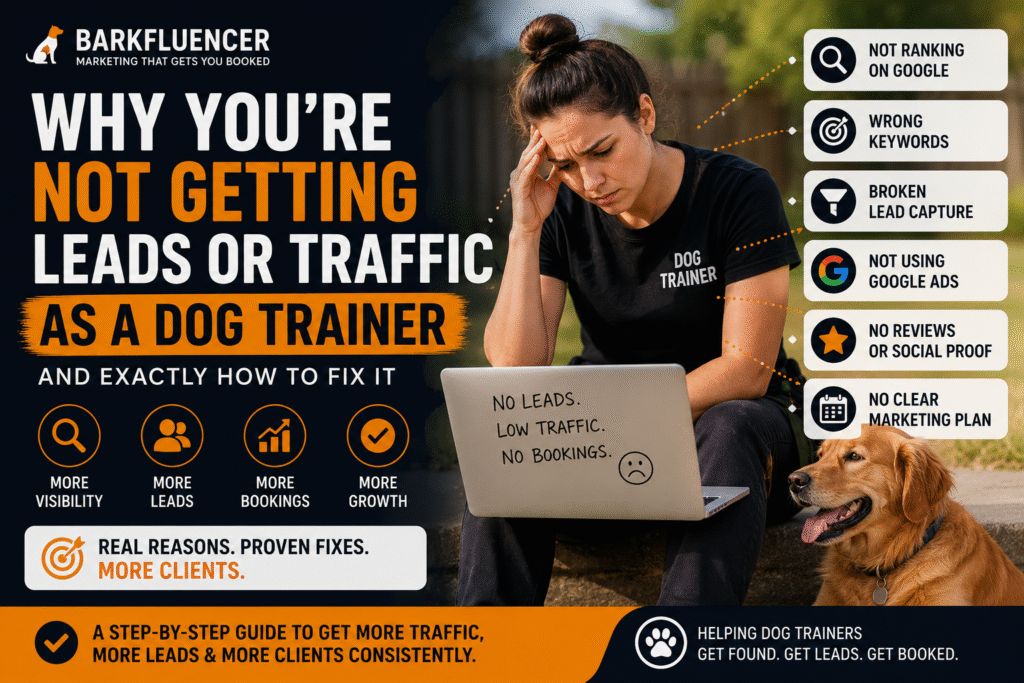
The honest, step-by-step breakdown of why most dog trainers get invisible online – and the specific fixes that change that, fast.
You’re good at training dogs. You have the certifications, the results, and the happy clients who can’t stop raving about you. And yet – your phone barely rings. Your website sits there doing nothing. Your Instagram posts get 14 likes and zero booking inquiries.
If that sounds familiar, you’re not alone. The majority of dog trainers we speak to share the same frustration: they know they’re good at their craft, but they can’t seem to turn that skill into a steady, predictable flow of new clients.
Here’s the hard truth: being good at training dogs and being visible online are two completely different skills. And in 2025, you need both.
This post breaks down the real reasons dog trainers don’t get enough traffic or leads – and gives you specific, actionable fixes for each one. No fluff. No vague advice about ‘posting consistently’. Just what actually works.
| 📊 INDUSTRY REALITY CHECK According to recent data, 97% of consumers search online before visiting a local business. Yet most dog training websites rank for fewer than 5 keywords and receive under 50 visitors per month. The gap between being skilled and being found is entirely a marketing problem – not a talent problem. |
| 97% | of dog owners search Google before choosing a trainer |
| <50/mo | average monthly visitors on a typical dog trainer website |
| 72% | of leads go to the trainer who responds first |
| 3.5× | more leads generated by trainers with Google Business Profiles |
1. Your Website Is Invisible on Google – Here’s Why
Most dog trainer websites are beautiful brochures that no one ever reads. They look great, they have nice photos of dogs, and they explain services clearly. But they don’t rank in Google search results because they weren’t built with SEO in mind.
Google ranks pages based on hundreds of signals – but the most important for a local service business are:
- Whether your pages target keywords that real people type into Google
- Whether your site loads fast and works properly on mobile
- Whether other reputable websites link to yours (backlinks)
- Whether your Google Business Profile is claimed and optimised
- Whether your location and service area are clearly stated on your website
The Most Common Website Mistakes Dog Trainers Make
- Home page headline says ‘Welcome to [Name] Dog Training’ – instead of a keyword like ‘Dog Trainer in [City] | Puppy & Obedience Training’
- No dedicated service pages – everything crammed onto one page means Google doesn’t know what to rank you for
- Images not compressed – a page that takes 6 seconds to load loses 53% of mobile visitors before they even see your content
- No meta titles or descriptions – Google writes its own, and it usually won’t include your city or main keyword
- No internal links between pages – Google can’t crawl your site efficiently
| ✅ QUICK WIN Open Google and type ‘dog trainer [your city]’. If your website doesn’t appear on page 1, your first job is local SEO – not more Instagram posts. Fix the foundation first. |
What to Fix First
Start with your Google Business Profile. It’s free, it’s powerful, and it directly affects whether you appear in the local map pack – the three business listings that appear at the top of local search results. Trainers who show up there get 3.5x more inbound inquiries than those who don’t.
- Claim and verify your Google Business Profile at business.google.com
- Choose ‘Dog Trainer’ as your primary category
- Add your full service area, business hours, and a keyword-rich description
- Upload at least 10 professional photos of you working with dogs
- Ask your last 5 happy clients to leave a Google review today
2. You’re Targeting the Wrong Keywords (Or None at All)
Keywords are the words and phrases dog owners type into Google when they need help. If your website doesn’t contain those phrases, Google will never show your site in the results – even if your services are exactly what the person is looking for.
The mistake most trainers make is using the language of a dog professional, not the language of a frustrated dog owner.
Dog professional language (what you say): ‘Positive reinforcement-based behaviour modification’ ↔ Dog owner language (what they search): ‘Dog trainer near me’, ‘how to stop my dog pulling on the lead’, ‘aggressive dog training help’
High-Value Keywords Dog Trainers Should Be Targeting
These are the types of searches that come with genuine intent to hire someone:
- dog trainer [city name]
- puppy training classes [city name]
- board and train dog trainer [city]
- aggressive dog trainer near me
- dog obedience training [city]
- how to stop my dog jumping
- puppy biting help [city]
- dog trainer for reactive dogs
| 💡 PRO TIP Go to Google and type ‘dog trainer’ then pause. Google will auto-suggest the most commonly searched completions. Every suggestion is a keyword someone in your area is actually typing. Write a page or blog post for each one. |
For each service you offer – puppy training, obedience, board and train, reactive dog work – create a dedicated page on your website that targets that service plus your location. One page cannot rank for everything. The trainers dominating Google have 8 to 15 pages, each targeting a specific keyword.
3. Your Lead Capture Is Broken
Here’s something that surprises most dog trainers: getting traffic and getting leads are two different problems.
Traffic means people visiting your website. Leads means people contacting you to book. A site can get 500 visitors a month and generate zero enquiries if the conversion experience is broken.
Signs Your Lead Capture Is Failing
- Your only contact option is a generic email address buried at the bottom of your contact page
- There’s no clear, prominent call to action on your homepage (‘Book a Free Consultation’, ‘Get a Quote’, ‘Call Now’)
- Your contact form has 8+ fields – every additional field drops your form completion rate
- You have no chat widget or fast response mechanism
- Your phone number is not clickable on mobile (this alone loses dozens of enquiries per month)
- You’re sending paid traffic to your homepage instead of a dedicated landing page
| ⚠️ THE 72% RULE Research consistently shows that 72% of leads go to the first business that responds. If someone fills out your contact form and waits 48 hours for a reply, they’ve already booked with a competitor. Your response speed is part of your marketing. |
What a High-Converting Dog Trainer Website Looks Like
The best-converting dog trainer websites follow a simple structure:
- Clear headline above the fold that states who you help and where (‘Puppy & Obedience Training in Austin, TX’)
- One primary call to action – a single button like ‘Book a Free Call’ or ‘Get Your Free Assessment’
- Social proof immediately visible – star rating, number of dogs trained, or a photo testimonial
- Brief service overview with a button for each service linking to dedicated pages
- Short ‘about’ section that builds trust – your certifications, your method, why you do this
- Contact form with 3 fields maximum: name, phone, and ‘tell us about your dog’
- Sticky phone number and WhatsApp button for mobile visitors
4. Social Media Is Draining Your Time Without Generating Leads
Posting on Instagram every day and getting 14 likes is not a lead generation strategy. It’s a content hamster wheel that keeps you busy without moving your business forward.
Social media is not where dog owners go when they’re ready to hire a trainer. They go to Google. Social media is where they go after they’ve already hired someone and they’re looking for tips and entertainment.
This doesn’t mean social media is useless – it means you have to use it correctly.
What Social Media Actually Does Well for Dog Trainers
- Builds trust and credibility once someone has already found you through Google
- Allows retargeting if someone visits your website, you can pay to show them ads while they scroll Instagram
- Video content showing your training results is one of the highest-converting formats for paid ads
- Your Google reviews and Facebook reviews cross-reference each other as social proof
The mistake is treating social media as your primary client acquisition channel. Use it as a trust amplifier and retargeting vehicle – not as your lead source.
| 💡 SMARTER APPROACH Instead of posting 5 times a week hoping someone books, spend that time creating one detailed blog post targeting a keyword like ‘puppy training [your city]’. That blog post will generate organic traffic and leads for the next two years. One well-optimised blog post outperforms 200 Instagram posts in terms of long-term lead generation. |
5. You’re Not Running Any Paid Advertising – Or You’re Running It Wrong
Organic SEO takes 3 to 6 months to produce consistent results. If you need leads now, paid advertising – specifically Google Ads – is the fastest way to get them.
Google Ads puts your business at the top of search results the moment someone searches ‘dog trainer near me’. Unlike social media ads where you interrupt someone’s scroll, Google Ads capture people at the exact moment they’ve decided they need help.
Why Most Dog Trainers Waste Money on Google Ads
- They send ad traffic to their homepage instead of a dedicated landing page – conversion rates drop from 25% to 3%
- They run ads without Google conversion tracking installed – they’re flying blind on what’s working
- They use broad match keywords that show ads for ‘dog trainer movies’ and ‘dog training treats’
- They don’t exclude searchers outside their service area
- They stop ads after 2 weeks and declare ‘Google Ads don’t work’
| 📊 WHAT GOOD NUMBERS LOOK LIKE A well-managed Google Ads campaign for a dog trainer in a mid-sized US city should generate leads for $20–$60 each. If your average client is worth $400–$2,000, that’s a strong return. If you’re paying $150+ per lead, the problem is almost always the landing page, not the ads. |
The Minimum You Need Before Running Ads
- Google conversion tracking installed and verified
- A dedicated landing page (not your homepage) with one clear call to action
- Google Business Profile claimed and fully optimised
- At least 5 Google reviews (social proof reduces ad cost by improving Quality Score)
- A follow-up system so leads are contacted within 30 minutes
6. You Don’t Have a Review Generation System
Reviews are the currency of local service businesses. The trainer with 47 five-star Google reviews will get the call every time over the trainer with 3 reviews – even if the 3-review trainer is more skilled.
Most dog trainers get reviews the same way: by accident, when a client feels moved enough to leave one. This produces a handful of reviews over years. A system produces reviews consistently.
A Simple Review Generation System That Works
- At the end of every successful session, say: ‘Would you be willing to share your experience on Google? It genuinely helps other dog owners find us – I’ll send you the link right now.’
- Send a text or email immediately after with a direct link to your Google review page (not your homepage – the actual review URL)
- Follow up once, 3 days later, if they haven’t left one
- Thank every reviewer publicly – Google sees this engagement positively
Done consistently, this produces 2 to 4 new reviews per month without any paid tools or complicated software. Forty reviews over a year puts you at the top of your local pack.
7. You’re Relying on Referrals as Your Only Strategy
Referrals are the best kind of lead – they arrive pre-sold and trust you already. But they’re also completely outside your control. You can’t predict when they arrive, how many you’ll get, or whether they’ll be a good fit for your services.
Relying on referrals alone means your income is unpredictable. A slow month isn’t a sign that you’ve done something wrong – it’s just a sign that not enough of your clients happened to talk about you that month.
The goal is to build marketing systems that generate leads predictably regardless of whether referrals arrive. Referrals become a bonus, not the plan.
| 🎯 THE COMPLETE SYSTEM The dog trainers consistently generating 10–20+ new client enquiries every month are running all of these simultaneously: optimised Google Business Profile, SEO-rich website with dedicated service pages, Google Ads targeting high-intent keywords, a review generation process, and basic email follow-up. None of these alone is enough. Together, they compound. |
Your 30-Day Action Plan
Here’s what to do in the next 30 days, ordered by impact:
Week 1 – Fix the Foundation
- Claim and fully optimise your Google Business Profile
- Make your phone number clickable on mobile
- Add a clear, prominent call-to-action button to your homepage
- Ask your last 5 clients for a Google review with a direct link
Week 2 – Fix Your Keywords
- Rewrite your homepage title tag to include ‘Dog Trainer [City]’
- Create one new service page targeting your most in-demand service plus your city
- Write one blog post targeting a question your ideal clients actually ask Google
Week 3 – Fix Lead Capture
- Reduce your contact form to 3 fields maximum
- Add a WhatsApp or call button sticky on mobile
- Set up a Google conversion tracking goal for form submissions
Week 4 – Start Paid Advertising
- Create a dedicated landing page (separate from your homepage) for Google Ads
- Launch a Google Ads campaign targeting ‘[your service] [your city]’ keywords
- Set a daily budget of $15–$25 to start – you need data before you scale
Ready to Stop Guessing and Start Growing?
Barkfluencer works exclusively with dog trainers. We build the complete marketing system – SEO, Google Ads, website, and lead generation – so you can focus on training dogs instead of chasing clients.