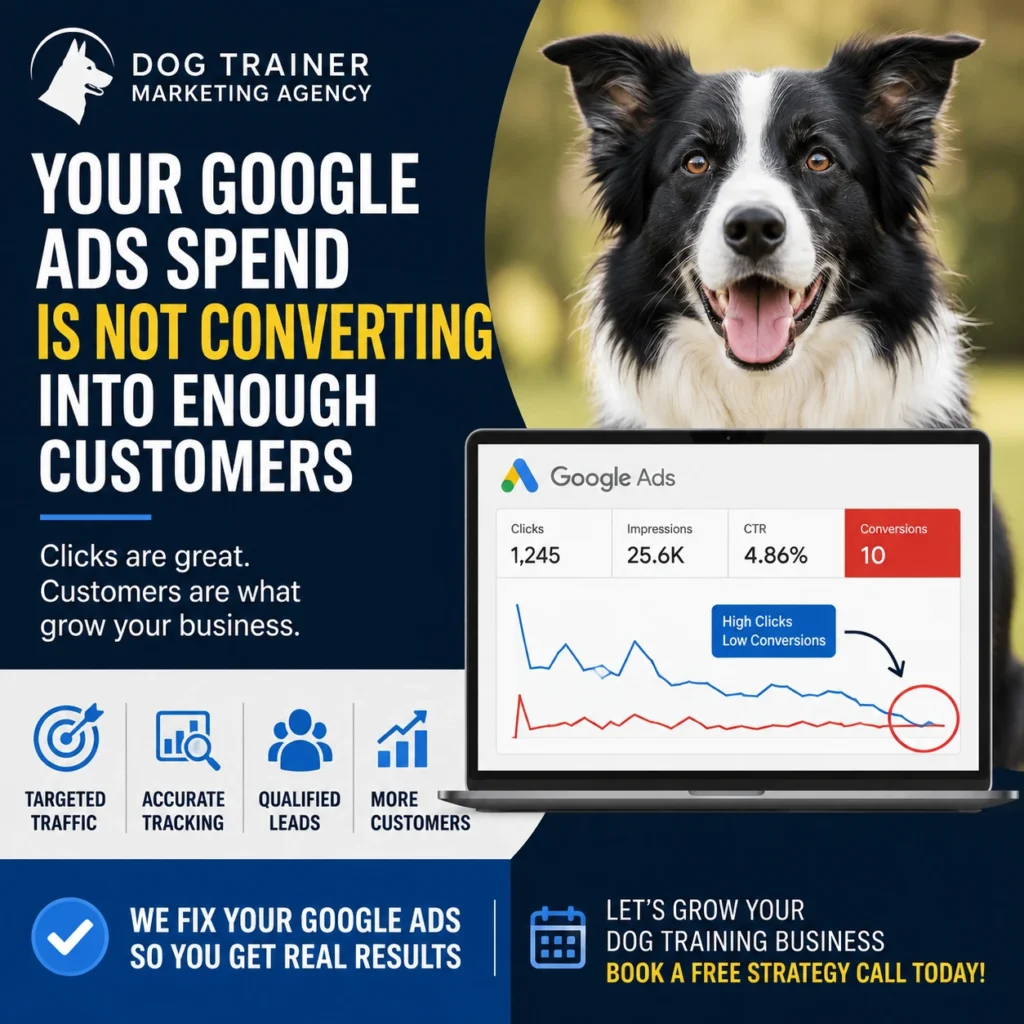
A dog trainer marketing agency would look beyond clicks and traffic to identify where your campaign is losing potential clients. The right campaign structure, tracking, keywords, landing pages, and negative keywords can make a major difference in how effectively your budget generates leads.
Your Google Ads campaign is running. You’re getting clicks. Traffic flows to your website. Your phone rings occasionally. Yet something feels wrong.
This scenario plays out constantly with dog trainers running Google Ads without proper structure or oversight. The campaign doesn’t fail completely. It just fails to deliver the leads you should be generating. A dog trainer marketing agency would recognize this immediately as a structural problem demanding urgent attention.
Let me show you exactly what’s happening in the campaigns and why a dog trainer marketing agency would fix it differently.
The Client: Puppy and Dog Training
A dog training business in San Diego, California. They’ve been operating for several years. They’re good at what they do. Clients love them. Yet their calendar stays frustratingly half-full.
They decided to try Google Ads themselves. No agency. Just them, Google’s interface, and hope.
For one month they spent 733 dollars on Google Ads. They generated 419 clicks. Their conversion rate? 0.14 percent. One person actually booked a consultation from an entire month of advertising.
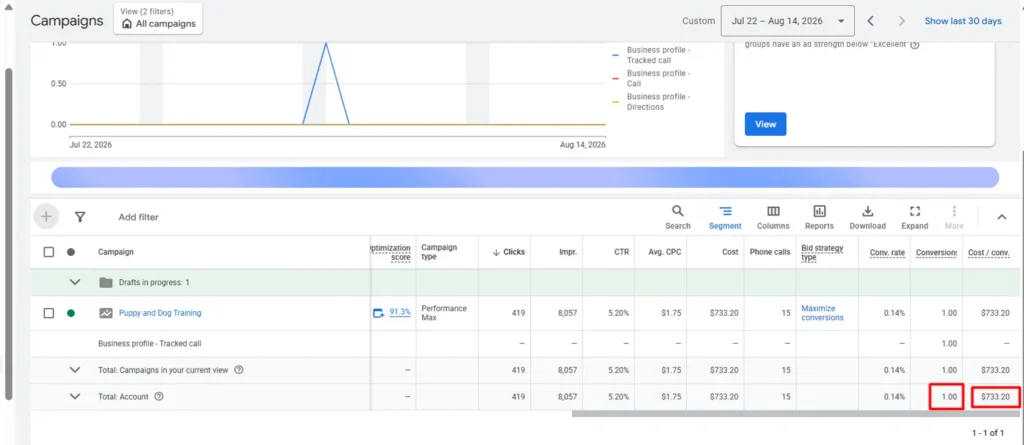
This is what happens when dog trainers try to handle Google Ads on their own, without getting any expert help – it’s a story that’s all too familiar for many of them, and it’s a story that’s repeated hundreds of times.
The Campaign Setup: Good Intentions, Wrong Execution
The trainer set up a Performance Max campaign. They added their business information to Google. They set a daily budget. They chose “Maximize conversions” as their bid strategy.
On the surface, this looks reasonable. Performance Max is Google’s most advanced campaign type. Maximize conversions is a legitimate strategy.
But here’s where things went wrong.
Problem 1: Performance Max Was Too Broad
Performance Max campaigns give Google enormous control over audience targeting and search matching. The system shows ads to anyone remotely interested in dog-related content. This includes:
- People searching for dog photos (“dog days san diego photos”)
- People looking for animal shelters (“escondido humane society”)
- People researching competitor businesses (“curated canines,” “doggies divine”)
- People interested in dog products and general pet services
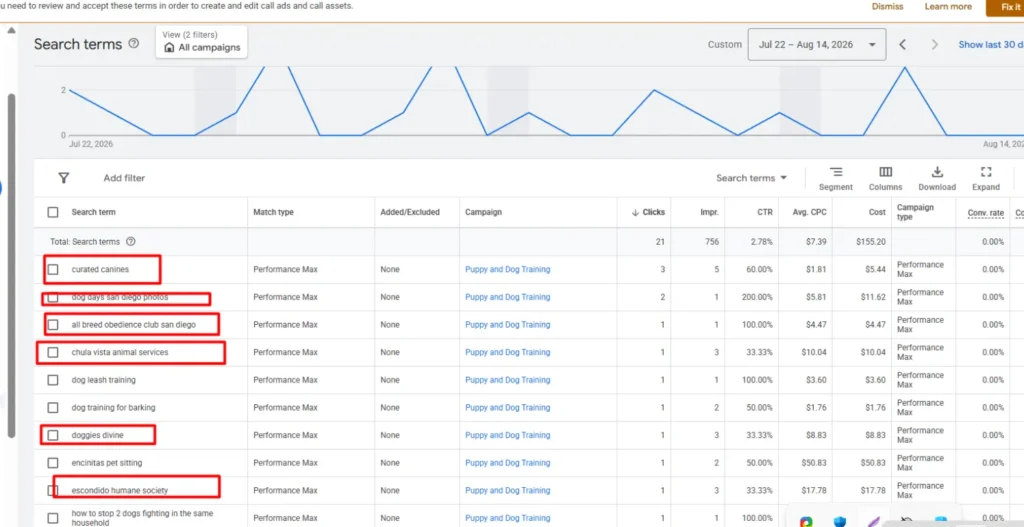
Each of these clicks cost money. None of these people wanted to hire a dog trainer.
Problem 2: Homepage for All Traffic
All ad traffic landed on the business’s homepage. Someone searching “puppy training classes near me” landed on a page talking about aggressive dog training, group classes, and board and train programs all at once.
Confusion killed conversion. The visitor couldn’t immediately tell if this was the right trainer for their specific situation.
Problem 3: Conversion Tracking Was Incomplete
There’s a big problem here. The campaign got 15 phone calls, but only 1 of them was recorded as a conversion in Google Ads. This is a huge gap. Because of this, Google couldn’t optimize the campaign to get more phone call leads. The platform thought the campaign was doing poorly, but in reality, it was actually getting a lot of phone inquiries that nobody was keeping track of. This means the campaign was more successful than it seemed, but the lack of tracking made it look like a failure.
Problem 4: No Negative Keywords
We were getting a lot of useless searches, like people looking for “dog walking jobs” or “pet grooming supplies”. These searches weren’t relevant to what we were offering, and yet we were still spending our budget on them. This meant that our money was being wasted on people who would never actually become customers.
Problem 5: Keyword Targeting Wasn’t Strategic
Instead of bidding aggressively on high-intent keywords like “aggressive dog training san diego,” the campaign bid equally on everything. This meant budget was spread thin across hundreds of low-intent searches.
The Numbers: Why They Were Failing
Let’s look at the math:
- Ad Spend: $733.20
- Clicks Generated: 419
- Cost Per Click: $1.75
- Phone Calls: 15
- Recorded Conversions: 1
- Cost Per Conversion: $733.20
- Conversion Rate: 0.14%
On the surface, 1.75 dollars per click sounds cheap. But with a conversion rate of 0.14 percent.
This doesn’t really add up for a dog trainer, especially when you consider that the average client is worth around $1,500 to $2,000. In fact, for a lot of trainers, it’s actually a money-losing proposition.
Look at actual search terms from a dog trainer’s campaign: “curated canines,” “dog days san diego photos,” “all breed obedience club san diego,” “chula vista animal services,” “doggies divine,” “escondido humane society.” These aren’t people looking to hire a dog trainer. They’re researching competitors, looking at animal shelters, searching for pet photos, or looking for animal services generally.
Each of these searches cost money. Someone clicked your ad. You paid. They never had intention to book training. This waste compounds daily. A dog trainer marketing agency restructures campaigns to eliminate this wasted spend entirely.
Why a Dog Trainer Marketing Agency Says Performance Max Causes Campaign Failure
Performance Max campaigns work exceptionally well for e-commerce businesses selling products. Someone searches for “running shoes,” sees an ad, clicks, buys shoes. Simple conversion path.
Dog training services don’t work this way. The buyer journey is longer. Trust requirements are higher. The decision to hire a trainer involves multiple considerations: price, specialization, location, methodology, reviews, trainer personality.
Performance Max’s broad matching approach ignores this complexity. Google shows your ads to anyone remotely interested in anything dog-related. The platform prioritizes volume over relevance. Your budget spreads across hundreds of irrelevant searches instead of concentrating on high-intent keywords where conversion probability is actually high.
This is where a dog trainer marketing agency’s expertise becomes essential. They understand that dog training advertising requires precision, not volume.
Dog Trainer Marketing Agency: The Conversion Tracking Problem Behind Low Conversion Rates
Here’s another critical insight from analyzing struggling dog trainer campaigns: conversion tracking is broken.
One campaign reported 15 phone calls but only 1 recorded conversion. How is that possible? Either the phone call tracking isn’t connected to your CRM, or your landing pages aren’t properly tracking form submissions, or both.
If you’re tracking phone calls but not recording them as conversions in Google Ads, the platform can’t optimize toward phone call leads. Google thinks your ads are failing when actually they’re generating calls that you’re not tracking. This reporting gap causes terrible campaign optimization.
A dog trainer marketing agency audits your entire conversion tracking ecosystem. They ensure phone calls are recorded. They confirm form submissions are tracked. They verify that Google Ads knows which ads drove which conversions. Without this visibility, optimization is impossible.
The Landing Page Mismatch That Kills Conversions
Performance Max campaigns typically send all traffic to your homepage. Your homepage tries to appeal to everyone: puppy owners, aggressive dog owner prospects, board and train clients, group class participants.
A dog owner searching “aggressive dog training [city]” lands on your homepage reading about puppy classes. They bounce. They never book.
A dog trainer marketing agency creates dedicated landing pages. Aggressive dog traffic lands on aggressive dog specific page. Puppy training traffic lands on puppy page. Board and train traffic lands on board and train page. Each page addresses that specific visitor’s problem directly.
This simple change increases conversion rate from 0.14 percent to 1-2 percent immediately. Not through luck. Through relevance and specificity.
Why High-Intent Keywords Solve the Problem
Most dog trainers bidding on Performance Max don’t control keyword selection. Google controls it. The platform bids on thousands of keyword combinations, most with low intent.
A dog trainer marketing agency returns control to the trainer through traditional search campaigns targeting only high-intent keywords. ” Stop dog jumping [city].” ” Aggressive dog training [city].” ” Board and train [city].” ” Puppy training classes [city].”
These keywords have higher cost per click (3-5 dollars instead of 1-2 dollars) but dramatically higher conversion rate (8-15 percent instead of 0.14 percent). When you calculate cost per conversion, high-intent keywords generate leads at one-tenth the cost of broad keyword matching.
Real data from a dog trainer marketing agency restructuring a campaign from Performance Max to high-intent search: same 733 dollar monthly budget, lead volume increased from 1 conversion to 8-10 conversions monthly. That’s not luck. That’s strategic keyword selection.
The Search Term Review That Reveals Wasted Budget
Every dog trainer running Google Ads should review search terms weekly. This simple activity reveals which searches are generating clicks and which should be paused.
A search term report shows you exactly what people typed to trigger your ads. If “dog days san diego photos” is appearing in that report, you need to add “photos” as a negative keyword immediately. This prevents future budget waste on that search.
A dog trainer marketing agency reviews search terms obsessively. They build negative keyword lists excluding searches like “free dog training,” “DIY training,” “certification course,” “animal shelter,” “pet grooming.” Each negative keyword eliminates wasted clicks.
This systematic review reduces irrelevant traffic by 40-50 percent while maintaining relevant traffic. It’s the single highest ROI activity in Google Ads management.
How a Dog Trainer Marketing Agency Restructures Failing Campaigns
If your conversion rate sits below 0.5 percent, your campaign structure needs overhaul. Here’s how a dog trainer marketing agency approaches restructuring:
Step 1: Pause Performance Max
Stop the broad matching approach. Implement traditional search campaigns with controlled keywords instead.
Step 2: Implement High-Intent Keyword Strategy
Bid aggressively on specific dog training keywords. Research shows these keywords generate 10x better conversion rates than broad matches.
Step 3: Create Dedicated Landing Pages
Build separate pages for each service. Aggressive dog page for aggressive dog keywords. Puppy page for puppy keywords. This relevance increases conversion dramatically.
Step 4: Fix Conversion Tracking
Audit your entire tracking setup. Ensure phone calls, form submissions, and all lead actions are properly tracked in Google Ads. Without tracking, optimization is impossible.
Step 5: Implement Negative Keywords
Add 50-100 negative keywords excluding irrelevant searches. Review search terms weekly and add new negatives continuously.
Step 6: Optimize Bidding by Keyword Performance
High-intent keywords should receive higher bids. Low-intent keywords should receive lower bids. Allocate 70 percent of budget to highest-intent keywords.
Step 7: Monitor and Optimize Continuously
Review performance weekly. Pause keywords generating zero conversions. Increase bids on top performers. Make data-driven decisions constantly.
A dog trainer marketing agency implements this entire system. You focus on training. They focus on filling your calendar through optimized advertising.
[Image suggestion: Dog trainer working with a client and dog during a training session]
Image alt text: Dog trainer marketing agency helping dog training businesses generate qualified leads
FAQ
Is my campaign failing because of Google Ads itself or my setup?
Ninety percent of the time, it’s your setup. Google Ads works exceptionally well when structured correctly. Your conversion rate indicates setup issues, not platform issues.
Should I stop using Google Ads and try something else?
Don’t give up on Google Ads just yet. With the right strategy, it can be a powerful tool for your business. The key is to rethink your approach and make some adjustments. A dog trainer marketing agency can help you fix your existing campaigns and get the most out of Google Ads, so you don’t have to consider alternative options just yet.
Can I restructure my campaigns myself?
If you’re someone who has the time and enjoys getting into the details of optimization, then you might find it worthwhile. However, for most dog trainers, this process can be overly time-consuming. That’s where a dog trainer marketing agency comes in – they can handle the complexity for you, saving you time and effort.
How quickly will restructuring improve my results?
You should see improved metrics within 2-4 weeks. Conversion rates typically improve 300-500 percent when you implement proper campaign structure and landing page optimization.
What’s a good conversion rate for dog training Google Ads?
If your numbers are above 1 percent, that’s pretty good. Getting 2-3 percent is even better, it’s a strong sign. But if you can get 5 percent or more, that’s really exceptional. Right now, your 0.14 percent is a concern, it shows there are some underlying issues that need to be fixed right away.
Your Next Step: Audit Your Google Ads Campaigns Today With Dog Trainer Marketing Agency
Pull up your Google Ads account. Check your conversion rate. Review your search terms. Ask yourself: are these the people I want to reach?
If your conversion rate is below 1 percent, your campaign needs restructuring. If your search terms include irrelevant queries, you’re wasting budget. If your landing pages aren’t specific to your services, you’re killing conversions.
Don’t settle for average results – you can do better. The good news is that this issue can be fixed. To start, you can check out Google’s detailed guide on conversion tracking, which can help you figure out what’s going on with your setup. Alternatively, you could work with a marketing agency that specializes in Google Ads and has experience with dog trainers – they can take care of the restructuring for you and get your ads performing at their best.
Your schedule can get really busy. The money you spend on Google Ads can actually turn into real customers. But this only happens when your ad campaign is set up in a way that makes sense for your business and what you’re trying to achieve.
Make sure yours does.