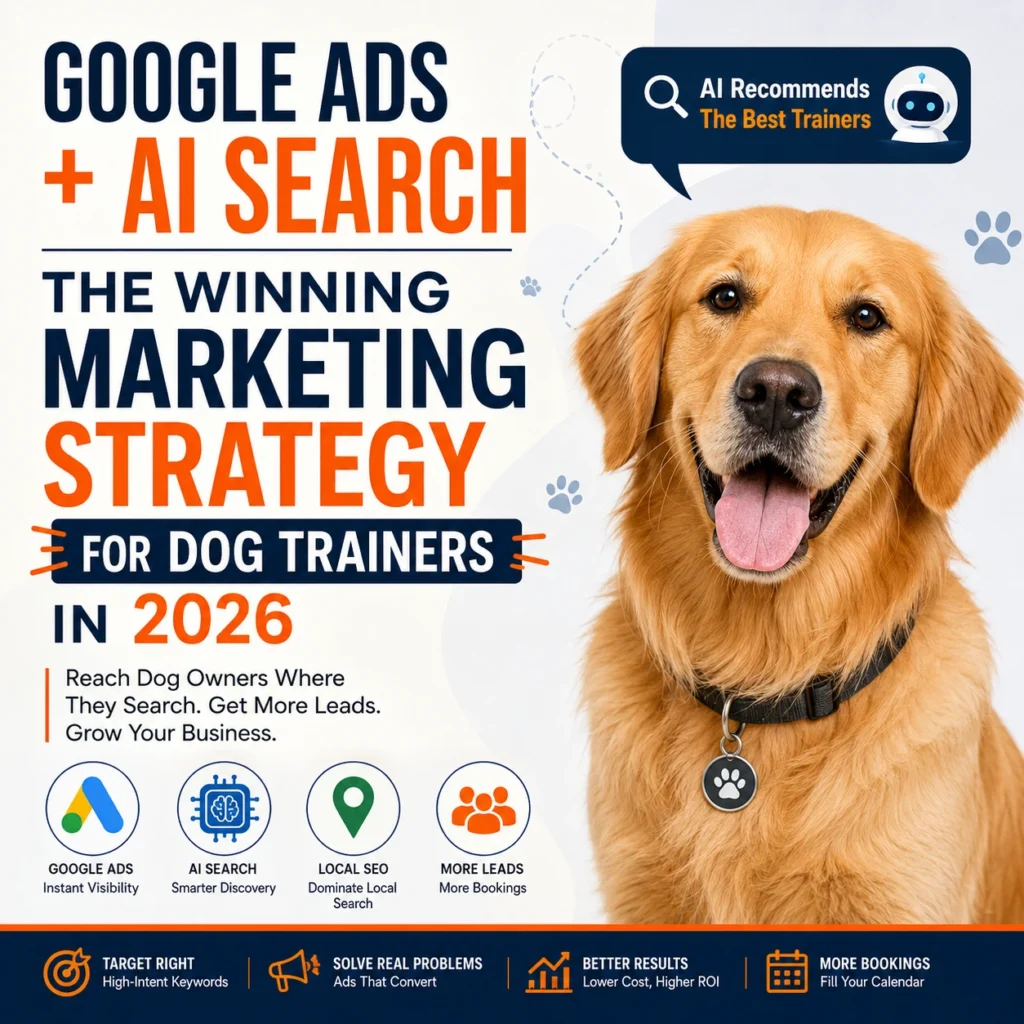
Google Ads for dog trainers remain one of the fastest ways to generate qualified leads and book more training sessions. While AI search is changing how dog owners discover local businesses, Google Search continues to capture people who are ready to hire a trainer. By combining Google Ads with AI search optimization, you can increase your visibility, attract more qualified clients, and grow your dog training business.
You’re great at training dogs. Your clients love you. Yet your calendar sits half-empty.
The problem isn’t your skill level. It’s visibility. Dog owners looking for your specific services can’t find you because you’re not showing up where they’re searching.
In this guide, you’ll learn how to build a Google Ads strategy for dog trainers, choose high-converting keywords, avoid wasted ad spend, and use AI search optimization to stay ahead of your competition.
Why Google Ads for Dog Trainers Still Matter in 2026 (And Your Marketing Needs to Evolve)
Five years ago, everything was Google Search. Now? Dog owners use multiple paths to find trainers.
Forty-five percent of dog owners under thirty use AI chatbots before typing into Google Search. They ask ChatGPT, “What should I look for in a dog trainer?” or “How do I find someone who specializes in aggressive dogs?” Meanwhile, older audiences still search traditionally. This fragmented search landscape means you can’t rely on a single marketing channel.
The trainers winning right now use a two-pronged approach. They run Google Ads for immediate visibility in search results. Simultaneously, they optimize their content to appear in AI recommendations. This combination captures prospects at every stage of their search journey.
Here’s the reality: Google Ads alone deliver results faster. You can launch ads today and generate leads tomorrow. But Google Ads alone leave money on the table because you’re ignoring the growing AI search audience.
The smartest dog trainers I work with combine Google Ads strategy with AI search optimization for dog trainers. This integrated approach costs slightly more upfront but generates 40-60 percent more qualified leads than either tactic alone.
Keywords That Actually Generate Qualified Leads (Not Just Clicks)
Most dog trainers bid on keywords incorrectly. They chase traffic volume instead of conversion probability.
“Dog training” sounds like an obvious keyword. Everyone searches it, right? Actually, no. Yes, people search it, but 80 percent of people searching broad terms like “dog training” are just researching. They’re not ready to buy. They’re not ready to book. You pay per click while 95 percent bounce without converting.
Smart trainers target problem-specific keywords instead. When someone searches “stop dog jumping,” they have an immediate problem. When someone searches “reactive dog training [city],” they’re close to making a hiring decision. These high-intent keywords convert at 8-15 percent instead of 1-2 percent.
Here’s your keyword strategy broken into tiers:
Tier 1 Keywords (Book These Immediately)
“Aggressive dog training [your city]” drives the highest ROI. These searchers have a serious problem and want to solve it.
“Board and train [city]” converts because people are actively comparing your service against competitors.
“Stop dog [specific behavior] [city]” works because it’s problem-specific and geographically targeted.
“Puppy training classes [city]” captures new dog owners ready to invest in training.
Tier 2 Keywords (Secondary Priority)
“Best dog trainer [city]” indicates someone comparing trainers.
“Certified dog trainer near me” shows they’re checking qualifications.
“Dog training methods” means they’re still learning, but education-focused searches sometimes turn into sales.
Tier 3 Keywords (Skip These)
“Dog training tips” attracts people wanting free information, not paid training.
“How to train a dog at home” indicates DIY interest, not professional service interest.
These keywords drain budgets without converting to bookings.
Negative Keywords: Your Secret Budget Savings
Negative keywords prevent your ads from showing for irrelevant searches. They’re the difference between profitable and wasteful Google Ads campaigns.
Add these immediately:
- Free
- DIY
- At home
- Certification course
- Online course
- Forum
Why?
Someone searching “free dog training” will never book you. Someone seeking a certification course wants to become a trainer, not hire one. These keywords waste budget on non-converting clicks.
Add location negatives too. If you only serve Austin, exclude “Dallas,” “Houston,” “San Antonio.” You’ll stop paying for clicks from people who can’t use your services anyway.
Cost-control negatives matter equally. Add:
- Cheap
- Discount
- Coupon
- Affordable dog training
Price-shopping searchers rarely become satisfied clients because their expectations don’t match premium training value.
Ad Copy That Speaks to Real Problems
Your Google Ads headline has three lines. Each one is valuable real estate. Use them strategically.
Line 1: State the Specific Problem You Solve
“Stop Your Dog’s Pulling and Jumping” beats “Professional Dog Training” because the reader immediately knows you understand their situation.
Line 2: Add Proof or Credibility
“CCPDT Certified. 12+ Years Specializing in Reactive Dogs” shows you’re legitimate and experienced.
Social proof works here too:
“Join 300+ Happy Dog Owners.”
Line 3: Include a Clear Action
“Book Your Free 20-Minute Assessment” creates momentum.
Vague phrases like “Contact Us” underperform dramatically.
Your description lines should expand on the solution, not repeat what you said in headlines.
After stating the problem and showing credibility, explain your approach:
“We use science-backed desensitization training. Your dog stays safe throughout. Most clients see results within 3-4 weeks.”
Then address objections in your second description line:
“Worried about cost? Payment plans available. Money-back guarantee if unsatisfied. We’ve transformed 250+ dogs.”
Landing Pages Make or Break Your Ads
Here’s a hard truth: Brilliant ads driving to weak landing pages waste 60 percent of your budget.
Your landing page needs to continue the conversation your ad started.
If your ad promises:
“Stop Your Dog’s Aggression”
your landing page should immediately show before-and-after photos of aggressive dogs transformed.
Not generic dog training content.
Specific, targeted content addressing that exact problem.
Keep Forms Short
Name, email, phone number.
That’s it.
Every additional field you add reduces conversion by 20-30 percent.
People won’t fill out extensive questionnaires just to book a consultation.
Display Your Phone Number Prominently
Sixty-five percent of dog training inquiries come via phone call, not form submission.
Make calling easy.
A big button that says:
“Call Now”
works better than small text at the bottom.
Mobile Optimization Isn’t Optional Anymore
Seventy-two percent of dog training searches happen on mobile devices.
If your landing page doesn’t work smoothly on phones, you lose three-quarters of your traffic.
The Complete Strategy for 2026 Visibility
Winning dog trainers combine Google Ads with AI search optimization for dog trainers.
Here’s how they execute simultaneously.
Step 1: Launch Targeted Google Ads (Immediate Visibility)
Use high-intent keywords from Tier 1.
Create problem-specific landing pages.
Track conversions from day one.
Step 2: Optimize for AI Search Visibility (Long-Term Compound Growth)
Publish blog content answering questions AI systems are being asked.
Structure content with clear headings phrased as questions.
Include direct answers in the first 150 words of each article.
Step 3: Build Integrated Content Strategy (Capture Traffic From All Channels)
Create landing pages optimized for both Google Search and AI search.
Use keywords naturally.
Write for humans first, search engines second.
Step 4: Monitor and Adjust (Data-Driven Decisions)
Track which keywords generate the best leads.
Track which content gets cited by AI systems.
Increase budget on top performers.
Pause underperformers.
Real Numbers From Trainers Doing This Right
A puppy training specialist in Denver started with 800 dollars monthly Google Ads budget.
First month:
6 leads at 133 dollars cost per lead.
After optimizing keywords, landing pages, and adding AI search content:
Month three:
18 leads at 44 dollars cost per lead.
Same budget.
Different strategy.
That’s a 70 percent reduction in cost per lead.
A board and train specialist added AI search optimization alongside Google Ads.
Traditional Google traffic stayed the same.
But three months later, she started appearing in ChatGPT recommendations for “dog training programs near me” questions.
Those AI-referred clients had 28 percent higher booking rate than cold ad traffic because they came pre-qualified and pre-convinced of the value.
These aren’t anomalies.
These are results from trainers who understand that 2026 dog training marketing requires mastering multiple visibility channels.
Your Action Plan (Start This Week)
Day 1: List Your Three Highest-Value Services
Aggressive dog training?
Puppy classes?
Board and train?
Day 2: Research Keywords Using Google Ads Keyword Planner
Focus on problem-specific keywords for your three services.
Day 3: Create One Problem-Specific Landing Page
Create one landing page for your highest-value service.
Day 4: Set Up Google Ads Account
Create first campaign.
Start with 1000 dollars monthly budget.
Day 5: Create One Blog Post Optimizing for AI Search
Answer a real question dog owners ask.
Phrase your headline as a question.
Include direct answer in first 150 words.
You don’t need perfection.
You need momentum.
Start with one campaign.
One landing page.
One AI-optimized article.
Track results for 30 days.
Then scale what works.
Continuing with the final section. Content is preserved and only formatted for WordPress readability.
Frequently Asked Questions
Will Google Ads Work If I’m In a Small Town?
Yes. Small towns actually have lower competition and lower cost per click.
Your advantage increases in smaller markets.
How Much Should I Spend Monthly?
Start with 500-1000 dollars.
This generates sufficient data to optimize within 30 days.
Scale after proving profitability.
Do I Need a Fancy Landing Page?
No. Clear, mobile-optimized, problem-specific works better than fancy.
You can build one in 2-3 hours with Leadpages or Unbounce.
How Long Until I See Results?
Google Ads deliver clicks immediately.
Qualified leads usually within 5-7 days.
AI search results take 2-4 weeks after publishing content.
Should I Do Google Ads or AI Search Optimization?
Both.
Google Ads is immediate.
AI optimization is long-term.
Combined they generate 40-60% more leads than either alone.
Your Next Step: Claim Your Online Visibility
Dog owners are searching for you right now.
They’re asking Google.
They’re asking ChatGPT.
The question is whether they find you.
Open Google Ads today.
Start with one campaign on one high-intent keyword.
Write one landing page.
Publish one AI-optimized article.
Watch what happens.
Dog trainers who master both traditional Google visibility and AI search visibility capture the most clients and generate the highest ROI.
Make sure you’re one of them.
Ready to get started? Book a free 20-minute strategy call to discuss your specific situation.
Your next clients are searching right now.
Let’s make sure they find you.