A dog owner whose puppy just chewed through a third pair of shoes opens Google and types “puppy training near me.” They’re not browsing. They’re not comparing five trainers over the next two weeks. They’re frustrated, they’re ready, and they’re going to click one of the first results they see.
That’s the moment Google Ads exists for.
Unlike SEO, which takes months to build, or social media ads that interrupt someone’s scroll, Google Ads puts your business directly in front of someone who has already decided they need a dog trainer – at the exact second they’re searching for one.
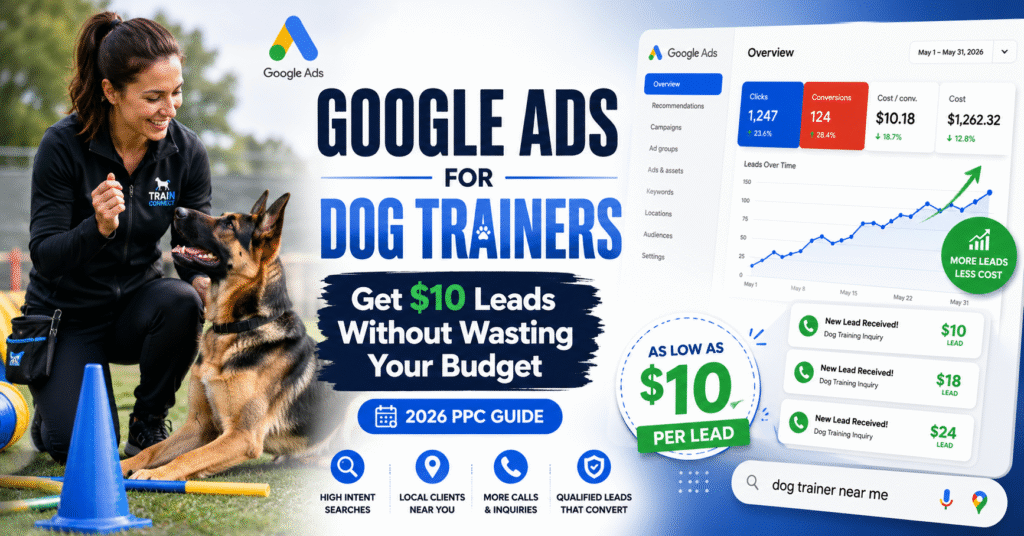
This guide breaks down exactly how dog trainers run Google Ads campaigns that generate leads for $10–$40 each, without wasting budget on clicks that never turn into clients.
Why Google Ads Make Sense for Dog Trainers in 2026
The core advantage of Google Ads over every other marketing channel is intent. Someone searching “dog trainer near me” has already made the decision – they need help, and they need it from someone local. Your job isn’t to convince them they need training. It’s to be the obvious choice the moment they’re looking.
Compare this to Facebook ads, which interrupt someone scrolling who wasn’t thinking about dog training at that moment – valuable for building awareness, but a longer path to a booking. Google Ads, by contrast, capture demand that already exists.
CPC for dog training keywords typically ranges from $3 to $10 per click depending on your market and competition. Compare that to a click for “dog bite lawyer” at around $229 – dog training is a relatively affordable, accessible space to advertise in, even for trainers running their business solo.
A monthly budget of $300–$1000 gives most local dog trainers enough data to identify what’s working and start generating consistent leads.
The 3 Google Ads Campaign Types Dog Trainers Should Know
Google Ads isn’t one thing – it’s a set of campaign types, each suited to different goals. For dog trainers, three matter most.
1. Search Ads (Start Here)
Search ads are the text ads that appear at the top of Google when someone types a relevant query. For most dog trainers, search campaigns are the most effective starting point – they’re the most direct way to capture someone actively looking for training services right now.
Search ads work on a pay-per-click model: you only pay when someone clicks. You control your daily budget and your maximum bid per click, giving you full visibility into spend.
2. Local Services Ads (LSAs)
Local Services Ads appear above standard search ads and carry a “Google Guaranteed” badge – a trust signal that can significantly increase click-through rates. Unlike standard search ads, LSAs charge per lead rather than per click, which can make them more cost-effective for service businesses.
The catch: you need to pass Google’s screening and verification process, which can include background checks and license verification depending on your location and category. It takes effort to set up – but the trust badge and lead-based pricing make it worth pursuing once your business is established.
3. Performance Max Campaigns
Performance Max campaigns are automated campaigns that show your ads across Google Search, Maps, YouTube, and Display simultaneously. Google’s algorithm learns which placements drive the most inquiries and shifts budget accordingly.
These work best once you already have conversion data from a Search campaign. Running Performance Max too early – before Google has data on what a “good lead” looks like for your business – often wastes budget on low-quality placements.
Recommended sequence for dog trainers: Start with Search campaigns to generate initial leads and conversion data. Add Local Services Ads once your business profile and reviews are strong enough to pass verification. Introduce Performance Max only after you have at least 30–50 conversions of data for Google’s algorithm to learn from.
Keyword Strategy: What Dog Owners Actually Search For
Keywords are the backbone of any Google Ads campaign – they determine when your ad shows up, and to whom.
Location-Based Keywords (Highest Priority)
Most dog owners search with their location in mind, even if they don’t always type the city name (Google often infers location from device data). Core keywords to target:
- dog trainer [your city]
- dog training near me
- puppy training [your city]
- dog obedience classes [your city]
- [your city] dog trainer
Service-Specific Keywords
Match keywords to the specific services you offer:
- puppy training
- dog behavior modification
- group obedience classes
- board and train [your city]
- reactive dog training
- leash training
Long-Tail Keywords (Lower Cost, Higher Intent)
Long-tail keywords – longer, more specific phrases – cost less per click and attract clients looking for exactly what a specialist offers. “Reactive dog trainer in Denver” costs less per click than “dog trainer” and attracts someone with a specific, urgent problem that matches your specialty perfectly.
If you specialize in a particular type of training – aggression, separation anxiety, service dog prep, puppy socialization – long-tail keywords around that specialty are often your highest-ROI opportunity. Less competition, lower cost per click, and a searcher whose need matches your expertise precisely.
Negative Keywords (Critical for Avoiding Wasted Spend)
Negative keywords tell Google which searches to exclude your ads from. Without them, your budget leaks to clicks that will never become clients.
Essential negative keywords for dog trainers:
- free
- online
- YouTube
- DIY
- jobs / careers / hiring
- course (unless you sell a course)
- salary (filters out people researching the dog training profession itself, not looking to hire)
Adding these from day one prevents your budget from being spent on people who were never going to book a session.
Writing Ad Copy That Converts Clicks Into Calls
Your ad copy has one job: convince someone with the right intent that you’re the right choice, in the smallest possible space.
Headline structure (3 headlines, Google rotates them):
Headline 1: Lead with the service + location – “Dog Trainer in [City] | [Business Name]” Headline 2: Lead with the outcome – “Calm, Obedient Dogs in 4-6 Weeks” Headline 3: Lead with credibility or offer – “Certified Trainer | Free Consultation”
Description lines:
Highlight credentials where relevant – certifications like CCPDT, IAABC, or Karen Pryor Academy signal expertise and build immediate trust in a few words. Mention your specific specialties (puppy training, reactivity, board and train) so the right searcher self-selects.
End with a clear, low-friction call to action: “Book your free consultation today” or “Call now for a free phone assessment.”
Ad extensions – don’t skip these:
Use ad extensions to show your phone number, star rating, and location directly in the ad. These extensions increase the visual size of your ad on the results page and give searchers more reasons to click – particularly the star rating extension, which displays your Google review score directly in the search results.
Landing Pages: Where Most Dog Trainer Campaigns Lose Money
Here’s the uncomfortable truth: a well-targeted ad with great copy can still fail completely if it sends traffic to the wrong page.
Send clicks to a landing page specific to the service searched – not your homepage. Someone who clicked an ad for “reactive dog training” should land on a page about reactive dog training specifically, not a general homepage where they have to search for relevant information themselves.
What a high-converting dog trainer landing page includes:
A headline that matches the ad’s promise – if the ad said “reactive dog training,” the landing page headline should immediately confirm they’re in the right place.
A single, obvious call to action – a form, a phone number, or a booking calendar. Not three competing options.
Social proof above the fold – a review snippet, star rating, or client count visible without scrolling.
A short explanation of your process – what happens after they submit the form or call. Reducing uncertainty increases conversion.
Mobile-first design – the majority of Google Ads clicks for local services come from mobile devices. A landing page that’s slow or hard to navigate on a phone loses leads regardless of how good the ad was.
If you’re running ads to your homepage right now, building dedicated landing pages for your top 2–3 services is likely the single highest-impact change you can make to your campaign’s performance – often improving conversion rates by 50% or more without changing your ad spend at all.
Budget Strategy: From $10/Day to a Full Calendar
Starting budget: $10–$20/day
If you’re new to Google Ads, start with a small daily budget and observe performance closely. This gives Google’s system enough signal to start optimizing without major financial exposure while you’re still learning what works.
The first 2 weeks: data collection, not judgment
Don’t evaluate performance in the first few days. Google’s algorithm needs time and data – typically 1–2 weeks – to understand which searches, times of day, and audiences convert best for your specific campaign.
Weeks 3–4: refine based on data
Review your search terms report – the actual queries people typed before clicking your ad. Add irrelevant terms as negative keywords. Pause keywords with high spend and zero conversions. Increase bids on keywords that are converting well.
Month 2 onward: scale what works
As you get more comfortable, increase your budget based on the number of leads or bookings you’re getting – not just clicks. If you’re getting lots of clicks but no leads, that’s a signal to revisit your landing page and ad copy before increasing spend.
Calculating your target cost per lead:
If your average client is worth $400 (a typical multi-session package) and you can comfortably afford to spend 15% of that on acquisition, your target cost per lead is around $60. At a $5 CPC and a 15% landing page conversion rate, that’s roughly $33 per lead – well within a profitable range.
The math changes based on your pricing and close rate, but the principle holds: know your numbers before you scale spend. A $10 lead that never converts is more expensive than a $40 lead that books a $2,000 board and train program.
Google Ads vs. SEO vs. Facebook Ads: Where Does Each Fit?
Dog trainers often ask which channel to prioritize. The honest answer is that each one does a different job – and the businesses growing fastest in 2026 use all three in combination.
Google Ads capture existing demand – people actively searching right now. Fast results, but spending stops the moment your budget does.
SEO for dog trainers builds long-term organic visibility for those same high-intent searches – slower to build (3–6 months), but the leads become essentially free once you rank.
Facebook Ads for dog trainers create demand – reaching dog owners who aren’t actively searching yet but fit your ideal client profile.
A common and effective sequence: run Google Ads immediately for fast leads while building SEO in the background. Once SEO starts producing organic traffic (typically months 3-6), Google Ads spend can often be reduced for your highest-competition keywords while remaining strong on long-tail and emerging searches. Facebook Ads run alongside both, building broader local awareness and filling group class spots that search-based intent alone won’t reach.
Common Google Ads Mistakes That Drain Budgets
Targeting keywords that are too broad Bidding on “dog training” alone – without location modifiers or negative keywords – attracts clicks from people anywhere, researching anything related to dogs and training. This is the single fastest way to burn through a budget with nothing to show for it.
Sending all traffic to the homepage As covered above, a homepage asks visitors to do the work of finding what they need. A dedicated landing page does that work for them – and converts significantly better.
Judging performance too early Pausing or dramatically changing a campaign after 2-3 days doesn’t give Google’s system enough data to optimize. Most campaigns need 1-2 weeks of consistent delivery before the data is meaningful.
Ignoring the search terms report This report shows you exactly what people typed before clicking your ad. Reviewing it weekly and adding irrelevant terms as negatives is one of the simplest, highest-impact maintenance tasks – and one most trainers never do.
No conversion tracking Without tracking which clicks turn into form submissions, calls, or bookings, you’re optimizing blind. Set up conversion tracking before you spend a single dollar – it’s the foundation everything else depends on.
Frequently Asked Questions
How much do Google Ads cost for dog trainers? CPC for dog training keywords typically ranges from $3 to $10 per click, depending on your market and competition level. A monthly budget of $300–$800 gives most local dog trainers enough data to identify what’s working. Long-tail, specialty keywords (like “reactive dog training [city]”) often cost less per click than broad terms like “dog trainer,” while attracting more qualified leads.
What is the best Google Ads campaign type for a dog trainer? Search campaigns are the best starting point for most dog trainers – they directly capture people actively searching for training services. Local Services Ads are a strong addition once your business is established and can pass Google’s verification, since they include a trust badge and charge per lead rather than per click. Performance Max campaigns work best after you have existing conversion data for Google’s algorithm to learn from.
How do I get cheap leads from Google Ads? Focus on long-tail, specialty keywords rather than broad terms – they have lower competition and cost less per click while attracting more qualified searchers. Add negative keywords (free, online, YouTube, DIY, jobs) immediately to prevent wasted spend. Send traffic to a dedicated landing page matching the specific service searched, rather than your homepage – this alone can improve conversion rates significantly without increasing spend.
Should I run Google Ads if I’m also doing SEO? Yes – they complement each other rather than compete. SEO takes 3–6 months to build meaningful organic traffic. Google Ads generate leads immediately while that foundation builds. Once your SEO starts ranking for your highest-value keywords, you can often reduce ad spend on those specific terms while maintaining ads for long-tail and emerging searches that SEO hasn’t covered yet.
How long does it take to see results from Google Ads? Unlike SEO, Google Ads can generate clicks and leads within hours of launching. However, meaningful optimization takes 1–2 weeks as Google’s algorithm gathers data on which keywords, times, and audiences convert best for your business. Most dog trainers see their cost per lead improve significantly between week 1 and week 4 as the campaign data accumulates and adjustments are made.
What’s the difference between Google Ads and Facebook Ads for dog trainers? Google Ads capture people actively searching for a dog trainer right now – high intent, ready to book, but only as long as you’re paying. Facebook Ads reach dog owners who fit your ideal client profile but aren’t actively searching at that moment – lower immediate intent, but often lower cost per lead and effective for building broader local awareness and filling group classes.
Ready for $10 Leads That Actually Book?
Google Ads put your dog training business in front of the exact people searching for help, right now, in your city. The difference between wasted budget and a full calendar comes down to the details: the right keywords, the right negatives, the right landing page, and the patience to let data guide decisions.
At Bark Fluencer, we manage Google Ads campaigns exclusively for dog trainers across the US – keyword research, ad copy, landing pages, conversion tracking, and ongoing optimization, all built around how dog owners actually search and book.
Book your free strategy call today →
We’ll show you exactly what a profitable Google Ads campaign looks like in your market – no obligation, no fluff.
Published by Bark Fluencer – the digital marketing agency built exclusively for dog trainers and pet professionals across the US.