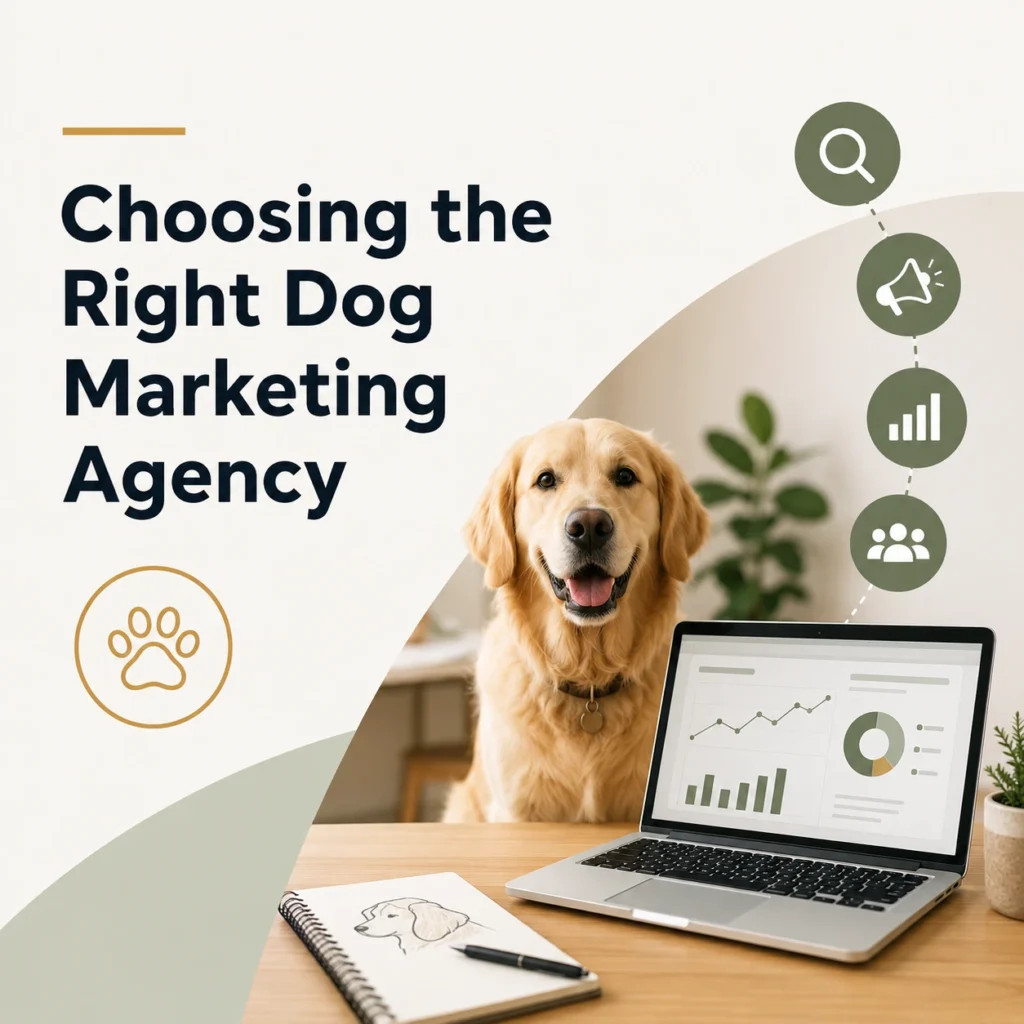
Why Choosing the Right Dog Marketing Agency Matters
Dog training business owners face a decision point. They’ve built a successful training operation. They know their craft. They understand dog behavior and training methodology. But marketing feels outside their expertise.
So they consider hiring a marketing agency. The thought makes sense: focus on what you’re best at (training dogs) and let experts handle marketing (attracting clients).
But not all marketing agencies understand dog training businesses. Some agencies specialize in e-commerce. Others work exclusively with software companies. They apply generic marketing tactics that fail in the pet services niche.
According to industry data, 67 percent of dog training businesses that hire a marketing agency report being unsatisfied with results. The agencies promise leads. They deliver minimal impact. The business owner wastes 3,000 to 10,000 dollars monthly without seeing return.
The problem isn’t that dog training marketing agencies don’t exist. The problem is that most dog training business owners don’t know how to evaluate them.
This guide provides the framework for choosing a dog marketing agency that actually understands dog training business, delivers measurable results, and generates sufficient leads to justify the investment.
Part 1: Understanding What Dog Marketing Agencies Do
The Scope of Dog Marketing Agencies
A dog marketing agency handles marketing responsibilities for dog training businesses. Scope typically includes:
Strategy development: Analyzing your market, competitors, and ideal clients to develop marketing strategy aligned with your business goals.
Content marketing: Creating blog posts, videos, social media content, and educational materials that attract dog owners searching for training.
Paid advertising: Managing Google Ads and Facebook Ads campaigns. Optimizing campaigns for lead generation and cost efficiency.
Email marketing: Building email lists, creating welcome sequences, and sending regular communication keeping prospects engaged.
Website optimization: Building or redesigning websites to convert visitors into leads. Landing page optimization and conversion rate improvement.
Social media management: Creating and posting content on Instagram, Facebook, TikTok, and other platforms.
Lead nurturing: Following up with prospects through email, phone, or scheduling systems to convert leads into clients.
Reputation management: Monitoring reviews, responding to feedback, and building positive online reputation.
Some agencies handle all these services. Others specialize in specific areas (Google Ads only, content marketing only, social media only).
Red Flags: What to Avoid
Certain characteristics indicate an agency is wrong for your business.
Red flag 1: Guarantees specific rankings or lead volume. Any agency promising “We’ll get you ranked for X keyword” or “We guarantee 50 leads monthly” is making promises they can’t control. Google algorithms change. Market conditions vary. Legitimate agencies provide no such guarantees.
Red flag 2: No dog training industry experience. If the agency has never worked with a dog training business, they don’t understand the niche. They apply generic marketing tactics that don’t work in pet services.
Red flag 3: Requires long-term contracts with early termination penalties. Agencies confident in results allow monthly contracts or short-term commitments. Agencies requiring 12-month contracts with penalties are betting you won’t notice poor results before being locked in.
Red flag 4: No clear reporting or performance metrics. If the agency can’t explain what they’re measuring, how they’re measuring it, or what results they’ve achieved, move on. Legitimate agencies provide transparent monthly reporting showing leads, costs, and results.
Red flag 5: One-size-fits-all approach. If the agency explains their process as “We do this for all clients,” they’re not customizing strategy to your unique business. Dog training businesses in competitive urban markets need different strategy than rural trainers. Aggressive dog specialists need different messaging than puppy training specialists.
Red flag 6: Poor communication or unresponsiveness. You should be able to reach your agency account manager within 24 hours. Monthly strategy calls should be standard. If the agency is hard to reach or communicates sporadically, that indicates they’re overbooked or disorganized.
Part 2: What to Look For in a Dog Marketing Agency
Industry Experience and Specialization
The best dog marketing agencies specialize in dog training businesses or broader pet services industry.
Evaluate their portfolio: Ask for case studies and examples of dog training businesses they’ve worked with. If they’re unwilling to share examples, they likely don’t have strong results.
Request references: Ask for contact information for three to five current or past dog training clients. Call these references and ask: Did the agency deliver results? Was communication good? Would you hire them again?
Understand their approach: Do they understand the dog training market? Can they explain the difference between marketing for puppy training versus aggressive dog training? Do they understand that aggressive dog specialists charge 2-3 times more than general trainers and therefore can spend 2-3 times more on client acquisition?
Team Composition and Capabilities
A strong agency has specialists across key marketing disciplines.
Look for: Content writer (or someone who can write well). Advertising specialist (someone who manages Google Ads and Facebook Ads). Tech person (handles website, email platforms, integrations). Project manager (coordinates between you and the agency team).
Small agencies might have one person wearing multiple hats. Large agencies might have dedicated specialists. Either can work. What matters is that they have competency across necessary disciplines.
Ask about the team: Who will be your primary contact? Who handles each discipline? Can you speak directly to the specialist handling your campaigns, or is all communication filtered through an account manager?
Specific Dog Training Marketing Capabilities
The best dog marketing agencies demonstrate expertise in tactics specific to dog training businesses.
Google Ads for dog trainers: Can they explain how to target high-intent keywords? Do they understand that “dog training” keywords have high competition but lower intent, while long-tail keywords like “aggressive dog training [city]” have lower volume but higher intent and lower cost per lead? Can they navigate the difference between search ads and local service ads?
Content marketing for dog trainers: Do they understand the difference between awareness content (blog about dog behavior), consideration content (comparison of training methods), and decision content (why hire a professional trainer)? Can they explain how to target location-based keywords like “dog training in [city]”?
Email marketing for dog trainers: Do they understand the need for segmentation (puppy owners, aggressive dog owners, board and train prospects)? Can they explain personalized email sequences?
Social media for dog trainers: Do they understand platform differences (Instagram for visual transformation content, TikTok for quick tips, Facebook for community engagement)?
Video strategy: Do they recommend YouTube and understand how training demonstration videos rank in Google search?
Pricing Structure and Transparency
Dog marketing agencies typically charge between 2,000 and 10,000 dollars monthly depending on scope and market competitiveness.
A breakdown of typical pricing:
Basic (small town, limited services): 2,000 to 3,500 dollars monthly. Usually includes content marketing or social media, not comprehensive strategy.
Mid-range (mid-size city, comprehensive services): 4,000 to 6,500 dollars monthly. Includes content, ads, email, social media, and lead nurturing.
Premium (competitive market, full service): 7,000 to 10,000 dollars monthly. Comprehensive strategy, managed advertising, website optimization, and dedicated account management.
Be skeptical of agencies quoting below 1,500 dollars monthly. They’re cutting corners. Be skeptical of agencies quoting above 15,000 dollars monthly unless you’re in a major metropolitan area with extremely high competition.
Important: Distinguish between service fees (what the agency charges) and ad spend (what you spend on Google Ads and Facebook Ads). An agency might charge 5,000 dollars monthly plus your ad budget (Google Ads: 2,000 monthly, Facebook Ads: 1,000 monthly). Your total marketing investment would be 8,000 dollars monthly.
Understand what’s included: Does the fee include ad spend? If you’re hiring them to manage Google Ads, are they charging a service fee plus passing through your ad budget? Or are they charging a flat fee and ad spend is separate?
Part 3: Questions to Ask Before Hiring
Strategic Questions
Question 1: “Walk me through your process for developing marketing strategy for a dog training business.”
Listen for: Do they ask questions about your business before proposing strategy? Do they understand different market segments (puppies vs. adult dogs, behavior modification vs. basic obedience)? Do they discuss competitive analysis and target audience research?
Red flag: If they start proposing tactics before understanding your business.
Question 2: “How do you measure success? What metrics do you track?”
Listen for: Do they discuss leads generated, cost per lead, conversion rate, return on ad spend? Do they have a specific reporting structure?
Red flag: If they talk vaguely about “brand awareness” without tying it to business results.
Question 3: “How long until we see results?”
Listen for: Do they explain realistic timelines? Content marketing takes 3-6 months to generate meaningful traffic. Paid advertising can generate leads immediately but requires 30-60 days to optimize.
Red flag: If they promise immediate results from organic channels like content marketing and social media.
Question 4: “What’s your experience with Google Ads for dog training businesses?”
Listen for: Can they explain bidding strategies? Do they understand quality score? Can they explain the difference between broad match, phrase match, and exact match keywords?
Red flag: If they can’t articulate how Google Ads work or seem inexperienced with advertising.
Operational Questions
Question 5: “What’s your typical client retention rate?”
Listen for: Agencies with 80+ percent client retention rates indicate satisfied clients. Agencies with lower retention rates lose clients, suggesting poor results or service.
Question 6: “Will we have a dedicated account manager?”
Listen for: Can you reach your account manager? How often will you communicate? Are strategy calls scheduled monthly or quarterly?
Red flag: If communication is ad-hoc or infrequent.
Question 7: “What tools and platforms do you use for tracking and reporting?”
Listen for: Do they use Google Analytics, Google Search Console, CRM systems? Can they show you examples of monthly reports?
Red flag: If they can’t explain how they track results or provide access to analytics platforms.
Question 8: “How do you handle underperforming campaigns?”
Listen for: Do they have a process for optimizing struggling campaigns? Do they pause unprofitable tactics? Do they test and iterate?
Red flag: If they maintain the same approach even when results decline.
Contract and Cost Questions
Question 9: “What are your contract terms?”
Listen for: Month-to-month agreements are ideal. If they require longer contracts, what’s the termination process? Are there penalties for early termination?
Red flag: Long-term contracts with high termination penalties.
Question 10: “How do you handle the budget if leads exceed expectations?”
Listen for: If their campaigns generate 50 leads monthly instead of predicted 20, do they recommend increasing investment? Decreasing ad spend to maintain consistent lead volume? This reveals whether they prioritize your profitability.
Red flag: If they recommend blindly increasing spend without discussing profitability.
Part 4: Red Flags in Proposal and Contracts
Vague Deliverables
Watch out for proposals that promise vague outcomes. “Increase brand awareness,” “boost online presence,” “improve marketing.” These aren’t measurable.
Good proposals specify exact deliverables: “Publish 4 blog posts monthly,” “manage Google Ads campaign with 50 dollar daily budget,” “send weekly email to email list of 500+ subscribers.”
Unrealistic Timelines
Proposals promising leads within two weeks from content marketing are unrealistic. Content takes 3-6 months to impact lead volume.
Proposals suggesting guaranteed top 3 rankings for competitive keywords ignore the reality that Google controls rankings and thousands of factors influence position.
Unclear Pricing Structure
If the proposal doesn’t clearly separate service fees from ad spend, ask for clarification. You need to know your total monthly investment and what each cost covers.
Penalty Clauses
Contracts including early termination penalties greater than one month of fees are unreasonable. If results disappoint at month three, you should be able to leave without onerous penalties.
Lack of Performance Metrics
Contracts without defined success metrics indicate unclear expectations. Before signing, agree on how success is measured. Monthly leads? Cost per lead below certain threshold? Conversion rate targets?
Part 5: Evaluating Agency Proposals
Request Comparative Proposals
Evaluate at least three agencies before deciding. Compare their approaches, pricing, and recommendations.
Create a comparison spreadsheet:
Agency name | Monthly cost | Included services | Timeline to results | Recommended tools
This structured comparison reveals which agency offers best value for your needs.
Assess Customization vs. Generic Approach
Look at each proposal. Is it customized to your business, market, and goals? Or does it read like a template with your business name inserted?
A customized proposal includes: Your competitive analysis, your market analysis, your specific goals, your target audience description, strategy tailored to your situation.
A generic proposal includes: Standard tactics, generic recommendations, boilerplate language.
Check Case Study Alignment
When agencies provide case studies, look for alignment with your situation. A case study showing a dog trainer in a small rural market growing 20 leads monthly is more relevant to you than a case study of an e-commerce company scaling digital sales.
Ask: Are the case studies from dog training businesses? Are they in markets similar to yours (city size, competitiveness)? Are the results achieved (20 leads monthly, cost per lead, revenue generated)?
Evaluate Price-to-Value Ratio
The cheapest agency isn’t necessarily the best value. An agency charging 2,000 dollars monthly delivering zero leads is expensive. An agency charging 6,000 dollars monthly delivering 30 profitable leads is relatively cheap.
Calculate cost per lead. If Agency A charges 3,000 dollars monthly and generates 10 leads, cost per lead is 300 dollars. If Agency B charges 5,000 dollars monthly and generates 25 leads, cost per lead is 200 dollars. Agency B delivers better value.
Part 6: Questions to Ask References
When contacting past or current clients of an agency, ask:
Reference Question 1: “What results did the agency deliver? Specifically, how many leads monthly did they generate?”
This gives you realistic expectations. If references say 5-15 leads monthly and the agency proposal promises 50 leads monthly, the proposal is unrealistic.
Reference Question 2: “What was the cost per lead? Did that improve over time?”
Expect cost per lead to decrease as campaigns optimize. If cost per lead remained high or increased, the agency isn’t optimizing effectively.
Reference Question 3: “How was the communication? Did the account manager respond to questions quickly?”
Communication quality reflects agency professionalism. Slow response times and poor communication indicate overbooked or disorganized agencies.
Reference Question 4: “Would you hire them again? Why or why not?”
This is the ultimate question. If references wouldn’t rehire the agency, that’s your answer.
Reference Question 5: “What could the agency have done better?”
References might reveal limitations or areas where the agency underperformed.
Part 7: The Onboarding Process
What Good Onboarding Looks Like
A strong agency provides structured onboarding ensuring clear communication and aligned expectations.
Week 1: Discovery call. Deep dive into your business, market, goals, and current marketing situation. Agency should ask 30-50 questions understanding your business thoroughly.
Week 2: Competitive analysis. Agency presents analysis of your top three competitors. What are they doing well? Where are opportunities?
Week 3: Strategy presentation. Agency presents marketing strategy based on discovery and competitive analysis. Strategy should be written and detailed.
Week 4: Campaign setup. Agency sets up tracking, establishes analytics access, configures email platforms, starts initial campaigns.
Week 5-6: Campaign launch. First campaigns go live. Initial targeting and messaging set up.
Week 7-8: Optimization begins. Based on initial performance data, agency makes adjustments to improve results.
Access and Transparency
A good agency provides you access to critical systems and data. You should have access to:
Google Analytics: See website traffic, visitor behavior, and where visitors come from.
Google Ads account: See campaigns, keywords, and performance data. You don’t need to manage it, but you should see it.
Email platform: Access to email list, email performance, subscriber segmentation.
Website analytics: Understand conversion rates, bounce rates, and user behavior on your site.
Monthly reports: Receive transparent reporting showing leads generated, cost per lead, and results by channel.
Agencies restricting your access to data or claiming “You don’t need to see that” are hiding something.
Part 8: Red Flags During the Relationship
Performance Issues
If three months into the engagement, you’ve received zero leads or leads cost 2-3 times your customer acquisition budget, address this immediately.
Give agencies 30-60 days to establish baseline performance and optimize campaigns. After 60 days, performance should be measurable.
If performance is poor after 60 days, either:
Agency understands the issue and has a specific plan to improve it (requires adjustment to messaging, different keywords, etc.). Give them another 30 days to implement improvements.
Agency doesn’t understand the problem or lacks plan to improve. Time to switch agencies.
Communication Issues
If your account manager is unresponsive, takes days to answer questions, or cancels regular calls, communication standards are declining. Address this directly.
A statement like “Our communication has been slower than I expected. Can we schedule weekly calls to improve alignment?” often corrects the issue. If the agency is unwilling to improve communication, switch agencies.
Billing Issues
If invoices are unclear, contain surprise charges, or don’t match your agreement, address immediately. A professional agency provides invoice breakdowns and clear billing.
Part 9: Knowing When to Switch Agencies
Objective Reasons to Switch
After 90 days: Agency has generated less than one lead monthly or cost per lead exceeds 500 dollars (when your average client value is 1,000 to 2,000 dollars).
After 180 days: Agency has generated 5-10 monthly leads but cost per lead hasn’t improved. No optimization is occurring.
After any period: Agency violates agreed contract terms. Missed deliverables, poor communication, unauthorized charges.
Subjective Reasons to Switch
You’ve lost confidence in the agency. Maybe they delivered results initially but recent communication or strategy changes make you uncomfortable.
You found a better option. If another agency shows demonstrably better results from references or proposals, switching might make sense.
You’ve outgrown the agency. As your business scales, you might need more sophisticated services or specialization the current agency can’t provide.
How to Switch Professionally
Review your contract for termination terms. Most month-to-month agreements allow termination with 30 days notice.
Provide notice in writing: “We’ve decided to take our marketing internally/with another agency. Our notice period is [30/60 days]. During this transition, please prepare all campaign materials, access credentials, and performance data for handoff.”
Get all materials and data before the relationship ends. You want historical data, campaign structures, email lists, and any other assets the agency created.
Part 10: Building Long-Term Agency Relationships
What Great Agency Relationships Look Like
Best agency relationships share characteristics:
Clear communication: Regular calls, responsive team, transparent reporting.
Aligned incentives: Agency profit improves when your lead generation improves. Not just a flat fee regardless of results.
Continuous improvement: Agency regularly optimizes campaigns, tests new tactics, and recommends adjustments.
Long-term perspective: Agency thinks about your business long-term growth, not extracting maximum fees now.
Honest feedback: Agency tells you when a tactic isn’t working, not just continuing ineffective campaigns to collect fees.
Compensation Structures Aligned with Results
The best agencies offer some performance-based compensation. Options include:
Hybrid model: Base fee (covers core services) plus performance bonus (additional payment if leads exceed target).
Cost-per-lead model: Agency charges only for leads generated, above a defined cost per lead target.
Revenue-share model: Agency takes percentage of client revenue generated from their marketing. Strongest alignment but rare in dog training industry.
Avoid purely transactional relationships where the agency collects fees regardless of results. These incentivize the agency to maintain status quo, not optimize.
Investing in the Relationship
The best relationships involve collaboration. Share your goals, challenges, and feedback. Participate in strategy development. Review reports and discuss optimization.
Agencies invest more effort in engaged clients who actively participate. Passive clients who just check in monthly receive less attention.
Conclusion: Choosing the Right Agency is an Investment
Choosing a dog marketing agency is one of the most important investments for your business. The right agency accelerates growth. The wrong agency wastes money and distracts you from training.
Use this guide as evaluation framework:
Look for agencies specializing in dog training or pet services.
Evaluate their portfolio and references carefully.
Ask specific questions about strategy, metrics, and tools.
Request customized proposals and compare at least three agencies.
Understand pricing structure and what’s included.
Check references and verify claims.
Start with month-to-month contracts with clear performance expectations.
Monitor performance closely for first 90 days.
Maintain regular communication and review metrics monthly.
Be prepared to switch if results don’t materialize after reasonable time (60-90 days).
The investment in a good agency (4,000 to 8,000 dollars monthly) pays for itself if the agency generates 20-30 monthly leads at 200-300 dollar cost per lead and those leads convert to clients worth 1,000 to 3,000 dollars each.
You’re not just paying for marketing services. You’re paying for lead generation that fuels your business growth. Choose your agency carefully. The difference between great and mediocre agencies is the difference between thriving and struggling.
Ready to Grow Your Dog Training Business?
We know dog trainer marketing. And we know exactly what it takes to get your business in front of dog owners who are ready to hire.
Book your free marketing strategy call →
Tell us your city, your services, and your growth goal – and we’ll show you a clear plan to get there.