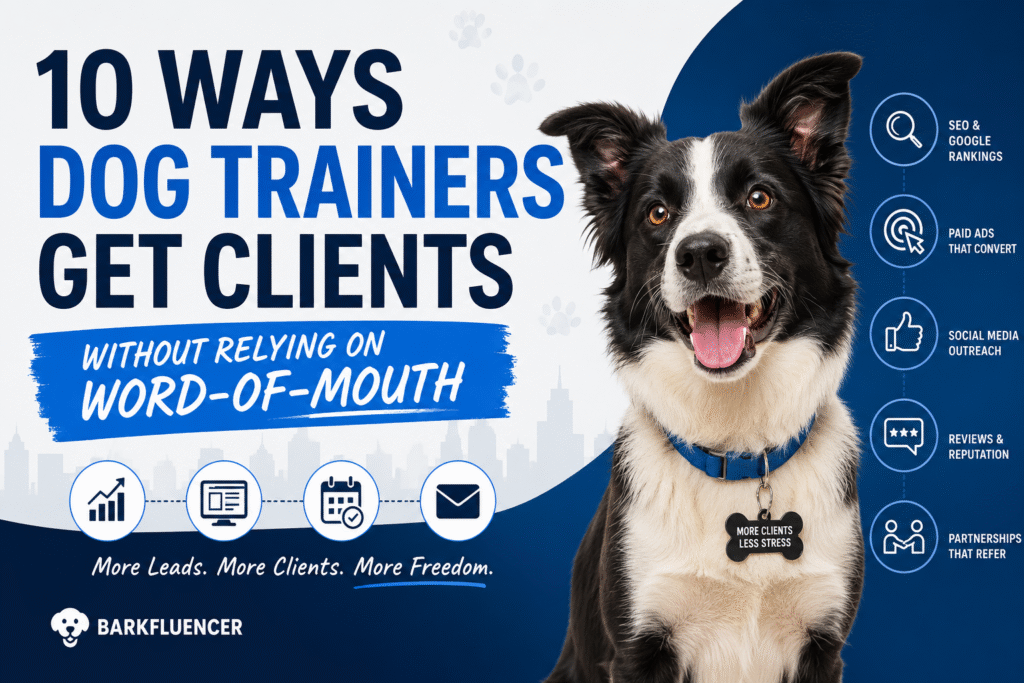
Word-of-mouth is great – until it isn’t.
One slow month, one dry referral streak, and suddenly your calendar has gaps you don’t know how to fill. If you’re a dog trainer whose business lives and dies by what past clients say to their friends, you’re one bad month away from real stress.
The good news? The most successful dog trainers in the US don’t rely on word-of-mouth anymore. They have systems – predictable, repeatable ways to get dog training clients flowing in every single month regardless of the season, the economy, or whether their last client happened to mention them to a neighbor.
Here are 10 of them.
1. Rank on the First Page of Google in Your City
When a dog owner in your city types “dog trainer near me” or “puppy training [city name]” into Google, three things happen: they see a map with three trainers, a few ads, and some organic results. If you’re not in that top section, you essentially don’t exist to that person.
Local SEO for dog trainers is the single highest-leverage marketing activity you can do in 2026. Unlike ads that stop the moment you stop paying, SEO compounds over time. A well-optimized page can bring in new leads every day for years.
The basics to get started:
- Claim and fully optimize your Google Business Profile (name, categories, services, photos, posts)
- Make sure your website mentions your city and service area clearly in headings and page copy
- Collect Google reviews consistently – aim for 20+ before expecting strong local rankings
- Build location-specific service pages if you cover multiple cities
This is the foundation everything else sits on. Dog trainers who invest in SEO for dog trainers early build a lead pipeline that pays them back for years.
2. Run Google Ads to Get Clients This Week
SEO takes time. Google Ads work immediately.
When someone searches “dog trainer [your city]” or “aggressive dog training near me,” they’re in buying mode. They need a trainer right now. Google Ads put you in front of that exact person at the exact moment they’re ready to hire.
A well-run Google Ads campaign for dog trainers can deliver leads for $15–$40 each – which, against a $150–$300 session or a $2,000+ board and train, is an exceptional return. The key is targeting the right keywords (high intent, local), writing ads that speak to the dog owner’s pain point, and sending clicks to a landing page built to convert.
Common mistakes that waste budget:
- Bidding on broad keywords like “dogs” or “pet training” (too vague, wrong intent)
- Sending ad traffic to your homepage instead of a dedicated landing page
- Not excluding negative keywords (people searching “free dog training,” “dog training videos,” “dog trainer salary” etc.)
Done right, Google Ads for dog trainers is the fastest way to fill your calendar while your SEO builds in the background.
3. Build a Website That Actually Converts Visitors Into Calls
Most dog trainer websites are digital brochures. They list services, show some photos, and have a contact form buried at the bottom. They don’t convert.
A high-converting dog trainer website does several specific things:
- Opens with a headline about the dog owner’s problem, not your credentials (“Stop the Pulling, Barking, and Jumping – For Good” beats “Welcome to [Name]’s Dog Training”)
- Makes it dead simple to take the next step – one clear CTA button above the fold
- Shows social proof immediately: reviews, client results, before/after stories
- Answers the questions dog owners are afraid to ask (pricing range, your methods, what happens if it doesn’t work)
- Loads fast on mobile – over 70% of local service searches happen on a phone
Think of your website as a 24/7 salesperson. If it’s not booking consultations while you sleep, it needs work.
4. Use Facebook and Instagram Ads to Reach Dog Owners Before They Search
Google Ads capture people who are already looking for a trainer. Facebook and Instagram ads reach dog owners before they even realize they need one.
Someone scrolling Instagram who just got a new puppy, or whose dog just started showing leash reactivity, is your ideal client. They haven’t Googled anything yet – but if your ad shows up in their feed at the right moment with the right message, they become a lead.
Facebook ads for dog trainers work especially well for:
- New puppy training offers (target new pet owners in your area)
- Behavior problem campaigns (“Does your dog pull, jump, or react to other dogs?”)
- Board and train promotions
- Free consultation offers to build your email list
The targeting available on Meta is extraordinary for local service businesses. You can reach dog owners within 10 miles of your location, in specific income brackets, who recently adopted a pet. No other platform gives you that precision for local outreach.
5. Partner With Veterinarians, Pet Stores, and Groomers
This is one of the most underused client sources in the dog training industry.
Think about who sees dog owners regularly before they think about training: vets, groomers, pet supply stores, doggy daycares, dog walkers. Every one of these is a referral source waiting to be activated.
How to build these partnerships:
- Walk in with a small stack of professional cards and a genuine introduction – not a sales pitch
- Offer to leave a simple one-page resource for their clients (“New Puppy Checklist” branded with your contact info)
- Refer their services to your clients too – reciprocal relationships last longer
- Offer the staff a free or discounted session so they can recommend you from personal experience
One strong vet partnership in a busy practice can send you 2–4 qualified referrals per month consistently. That’s 24–48 potential clients a year from a single relationship.
6. Collect and Showcase Google Reviews Systematically
Reviews are a vital part of your marketing – and most dog trainers collect them accidentally rather than systematically. That’s a massive missed opportunity.
Dog owners looking for a trainer read reviews the same way they read recommendations from friends. A trainer with 80 five-star reviews and detailed testimonials beats a trainer with 10 generic reviews every single time, regardless of actual skill level.
Build a review system:
- Send every client a review request via text within 24 hours of their final session (response rates are highest here)
- Give them the direct Google review link – don’t make them find it
- Ask a specific question: “What specific improvement did you notice in [dog’s name]?” – this produces keyword-rich, detailed reviews that help your local SEO
- Respond to every review, positive or negative, within 48 hours
Aim for 50+ Google reviews before you call your online reputation solid. At that volume, your star rating becomes a conversion asset on every ad and listing you run.
7. Create a Lead Magnet and Build an Email List
Most dog trainers have no email list. This means every lead they don’t immediately convert is gone forever.
A lead magnet is a free resource you offer in exchange for someone’s email address. For dog trainers, this could be:
- “5 Commands Every Puppy Should Know by 12 Weeks” (PDF guide)
- “The Reactive Dog Survival Guide” (checklist)
- “Why Your Dog Ignores You – and How to Fix It in 7 Days” (email mini-course)
Once someone downloads your lead magnet, you have their email. You can now send them a 4–5 email welcome sequence that builds trust, showcases your results, and invites them to book a consultation.
Collect emails during every client intake and class registration, and offer a free downloadable guide in exchange for an email signup on your website. This turns your website traffic into an owned audience – one no algorithm change can take away from you.
A modest list of 500 engaged dog owners in your area is worth more than 5,000 social media followers you can’t reach without paying for ads.
8. Post Consistently on Social Media (With a Strategy)
Posting random dog photos on Instagram won’t get you clients. Posting strategically will.
The content that actually drives bookings for dog trainers:
- Before/after transformation videos – show a reactive dog becoming calm, a pulling dog walking loose leash. These get shared and saved constantly.
- “Did you know” educational posts – position you as the expert, build trust before a client ever contacts you
- Behind-the-scenes content – a day in your life as a trainer, what a board and train session actually looks like
- Client testimonial clips – 30-second video of a happy client talking about results beats any ad you’ll ever write
- Direct response posts – “If your dog does [specific behavior], here’s why and here’s what to do – and if you want me to handle it for you, DM me”
The goal isn’t follower count. It’s building a local audience of dog owners who think of you the moment they decide they need a trainer. Consistency – 3–4 posts per week – matters more than perfection.
9. List Your Business on Every Relevant Directory
Beyond Google, there are dozens of directories where dog owners search for trainers. Most of your competitors aren’t on all of them.
High-value directories for dog trainers:
- Yelp – still heavily used for local service searches
- Nextdoor – hyperlocal, high-intent, trusted recommendations
- Thumbtack – active lead generation platform for local services
- Rover / Wag – while primarily for dog walkers, many pet owners use these to find trainers too
- APDT Trainer Search – used by pet owners specifically looking for certified, professional trainers
- Alignable – local business network, good for B2B referral partnerships
Each directory listing is also a citation – a mention of your business name, address, and phone number across the web. Consistent citations are a direct local SEO ranking factor. More citations = higher Google Maps rankings.
Spend two hours creating or claiming your listings on all of these. It’s one of the highest ROI activities a dog trainer can do in an afternoon.
10. Offer a Free Consultation (And Make It a Sales Conversation)
The biggest conversion lever most dog trainers ignore is their free consultation.
Being great with dogs doesn’t automatically bring clients. To build a successful dog training business, you need both professional training skills and a clear marketing strategy. The free consultation is where your marketing strategy meets your sales process – and most trainers treat it as a casual chat rather than a structured conversion opportunity.
A consultation that books clients every time:
- Ask about the dog’s specific problem first – let the owner describe their frustration in detail before you say anything. People feel understood, and you learn exactly what outcome to promise.
- Paint the picture of life after training – “Imagine walking your dog past another dog without any of that pulling and barking…” Future-pacing creates emotional buy-in.
- Present one clear recommendation – not three options at three price points. One clear package that solves their exact problem.
- Address the price question directly – don’t dance around it. Confident trainers name their price with confidence and explain why it’s worth it.
- Create a soft close – “I have two spots open next week. Which day works better for you?” A binary choice is easier to say yes to than an open-ended “let me know if you’d like to move forward.”
A structured consultation process can double your close rate without changing a single thing about your marketing.
The Common Thread Across All 10 Strategies
Every method on this list does one of two things: it puts you in front of dog owners who are actively looking for a trainer (Google SEO, Google Ads, directories), or it builds enough trust with dog owners that they choose you when the moment arrives (social media, reviews, email, partnerships).
Word-of-mouth does both of those things too — but passively and unpredictably. These 10 strategies do it actively and at scale.
The trainers growing fastest in 2026 are showing up in multiple places: Google search results, social media feeds, and local listings. They’re not relying on any single channel. They have a system.
You don’t need to implement all 10 at once. Start with the two or three that address your biggest gap right now – and build from there.
Frequently Asked Questions
How do dog trainers get their first clients? Start with the fastest channels: fully optimize your Google Business Profile, list yourself on Yelp, Nextdoor, and Thumbtack, and ask every person you know with a dog for one referral. This combination typically generates the first 3–5 clients within 2–4 weeks for a new trainer. From there, start building your reviews and investing in a proper website.
How much should a dog trainer spend on marketing? A general rule is 10–15% of your target monthly revenue. If you want to generate $5,000/month in training income, invest $500–$750/month in marketing. For trainers just starting out, Google Ads ($300–$500/month) plus a professional website is the highest-ROI combination. As revenue grows, add SEO and social media management.
How long does it take to get consistent dog training clients from SEO? Realistically, 3–6 months to start seeing consistent organic traffic, and 6–12 months to rank competitively for “dog trainer [city name]” searches. This is why running Google Ads simultaneously during the early months makes sense – ads provide immediate leads while SEO builds in the background.
What’s the best social media platform for dog trainers to get clients? Instagram and Facebook are the most effective for dog trainers. Instagram’s video features (Reels) are particularly powerful for before/after training transformation content, which gets high organic reach. Facebook is better for local community engagement and running ads to a hyper-targeted local audience. TikTok is growing quickly for reach, but Instagram and Facebook still convert better to local bookings.
Do dog trainers need a website to get clients? Yes – and not just any website. A professional, mobile-optimized website with clear calls to action, client testimonials, and local keywords is essential in 2026. It’s the hub that every other marketing channel (Google Ads, social media, directories, referrals) points back to. Dog owners check websites before they book anything. A poor website loses leads that every other part of your marketing worked hard to generate.
Ready to Stop Guessing and Start Growing?
You now have 10 proven ways to get dog training clients without depending on who your last client happens to mention you to.
The question is: which of these are you not doing right now?
At Bark Fluencer, we work exclusively with dog trainers. We build the marketing systems – SEO, Google Ads, Facebook Ads, and high-converting websites – that turn your expertise into a full calendar every single month.
Book your free strategy call today →
We’ll review your current online presence, identify your biggest growth gaps, and give you a clear plan – no fluff, no generic advice, just a strategy built for your dog training business.
Published by Bark Fluencer – the digital marketing agency built exclusively for dog trainers and pet professionals across the US.