Every day, thousands of dog owners in your city open Google and type some version of the same thing:
“Dog trainer near me.” “Puppy classes in [city].” “Dog obedience training [city name].”
What happens next determines whether your phone rings or your competitor’s does.
If your business appears in the top three results – the map pack and the first organic listings – you get the call. If you don’t appear, you don’t exist to that dog owner. They’ll never know how good you are with dogs. They’ll never read your reviews. They’ll book someone else and never look back.
That’s what SEO for dog trainers solves. Not website traffic for its own sake – actual, high-intent local dog owners finding your business at the exact moment they’re ready to hire.
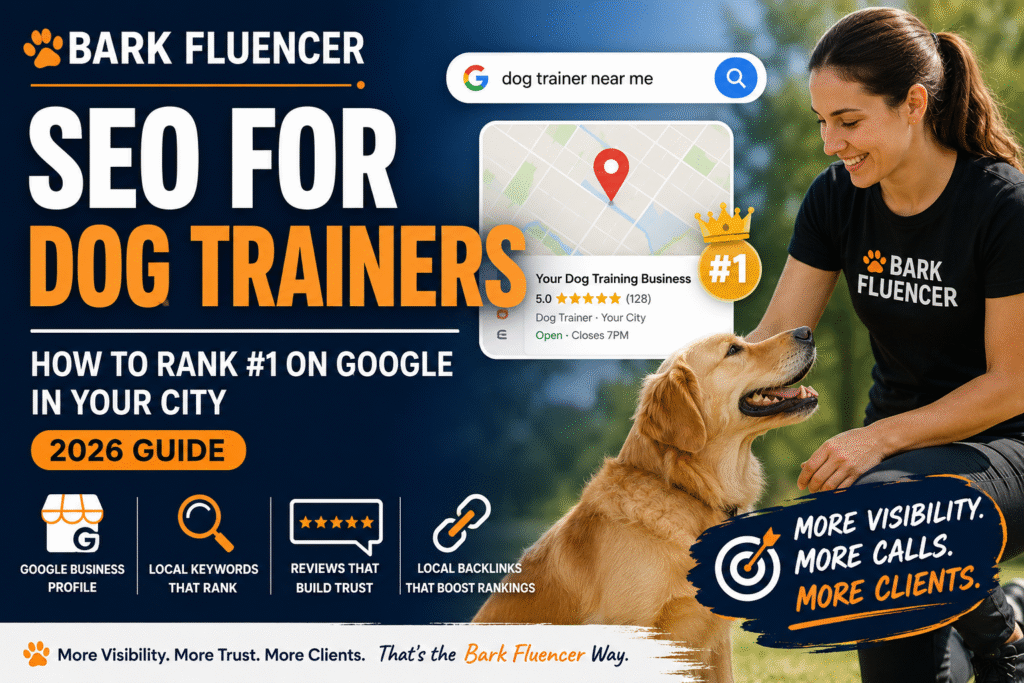
This guide covers every element of a local SEO strategy that gets dog training businesses to page one in 2026 – from your Google Business Profile to your website structure, content, reviews, and backlinks. No fluff, no generic advice, just the specific actions that move rankings.
What Is SEO and Why Does It Matter More Than Ever for Dog Trainers in 2026?
SEO – Search Engine Optimization – is the process of making your business more visible in Google’s search results without paying for ads. When someone searches “dog trainer [your city],” Google ranks businesses based on hundreds of signals. SEO is the work you do to send the right signals.
For dog trainers specifically, local SEO is what matters – not general SEO. Local SEO focuses on appearing in searches tied to a specific geography: your city, your neighborhood, your service radius. It’s what gets you into the Google Map Pack (the three businesses shown on the map at the top of results) and the organic listings below it.
Here’s why this matters more in 2026 than ever before:
46% of all Google searches carry local intent. “Near me” searches on mobile have grown over 250% in recent years. And mobile devices now generate 60% of all Google searches – meaning someone searching “dog trainer near me” from their phone while standing in a pet store parking lot is ready to call or book immediately.
These are not casual browsers. They’re buyers with a specific need, searching for a specific solution, in a specific location. When you rank for these searches, you capture clients who are already convinced they need training – you just have to show up.
The trainers who rank at the top aren’t necessarily the best trainers in the city. They’re the ones whose digital presence sends the strongest signals to Google. That’s entirely within your control – and this guide shows you exactly how to build it.
The 6 Pillars of Local SEO for Dog Trainers
Ranking on Google in your city requires consistent strength across six interconnected areas. Weakness in any one of them limits how high you can go. Master all six and you build a search presence that compounds over time – bringing in leads every month without ongoing ad spend.
Pillar 1: Google Business Profile – Your Most Powerful Ranking Asset
Your Google Business Profile (GBP) is the single most impactful local SEO asset a dog trainer has. For most local searches, it’s the first impression a potential client sees – before your website, before your reviews, before anything else.
Many dog trainers struggle here because of common mistakes: incorrect categories, weak descriptions, or inconsistent information between the profile and the website. Google rewards alignment. When your GBP says one thing and your website says another, rankings suffer.
How to fully optimize your Google Business Profile:
Business name: Use your exact business name – no keyword stuffing. “Jake’s Dog Training LLC” not “Jake’s Dog Training Best Trainer in Denver LLC.” Keyword-stuffed names violate Google’s guidelines and trigger penalties.
Primary category: This is the single biggest ranking lever on your GBP. Choose “Dog Trainer” as your primary category. Add secondary categories like “Pet Training Service” or “Animal Training Service” for additional coverage.
Description: Write a 750-character description that includes your primary keyword naturally (“dog training in [city]”), mentions your specific services, and ends with a call to action. Avoid generic language – be specific about what you do and who you help.
Services section: List every individual service you offer with a short keyword-rich description. Puppy training, obedience training, behavior modification, board and train, group classes – each one is a ranking opportunity for a different search query.
Photos: Upload minimum 20 high-quality photos. Include: team photos, dogs in training, your facility, before/after transformation examples, and client testimonials as image overlays. Profiles with strong photo galleries generate 42% more direction requests and significantly more website clicks than sparse profiles.
Google Posts: Publish at least two posts per week. Each post supports up to 1,500 characters, photos or videos, and a CTA button. Use posts to announce upcoming group classes, share training tips, promote limited-time offers, and reinforce local keywords. Posts about “Summer Puppy Training Tips for [City] Dog Owners” reinforce local relevance while providing value.
Q&A section: Seed your own questions and answers. Ask and answer the 8–10 questions dog owners most commonly ask – pricing range, methods used, how long training takes, whether you handle aggression cases. Unanswered questions in this section are a missed opportunity every time someone reads them.
Pillar 2: On-Page SEO – Making Your Website Readable for Google and Dog Owners
Your website needs to communicate clearly to two audiences simultaneously: the dog owners reading it and the Google bots crawling it. Strong on-page SEO makes both audiences understand exactly what you do, where you do it, and who you help.
Title Tags Every page needs a unique, keyword-rich title tag under 60 characters. Your homepage title tag should follow this structure: Dog Trainer [City] | [Your Business Name]
For service pages: Puppy Training [City] | [Business Name] or Board and Train [City] | [Business Name]
Meta Descriptions Write a unique meta description for every page – 150–155 characters, include the target keyword, and end with a CTA. Meta descriptions don’t directly affect rankings but they determine whether someone clicks your result. A compelling meta description on a page ranking #3 can outperform a weak one ranking #1.
H1 Headings Every page has exactly one H1 – and it must include your primary keyword. Your homepage H1 should mention both your service and your city: “Expert Dog Trainer in [City] – Obedience, Behavior, and Puppy Training.”
Keyword Placement in Body Copy Include your primary keyword in the first 100 words of your page content. Use it naturally 3–5 times across the full page – not stuffed, not avoided. Secondary keywords (specific services, neighborhood names, training methods) belong in H2 subheadings and body paragraphs.
NAP Consistency NAP stands for Name, Address, Phone number. These three pieces of information must be identical across your website, Google Business Profile, and every directory listing on the internet. A difference as small as “St.” vs “Street” creates inconsistency that confuses Google and dilutes your local authority. Audit your NAP across all platforms and standardize it.
Mobile Optimization and Page Speed 53% of mobile visitors abandon a site that takes more than 3 seconds to load. Since mobile devices generate 60% of local searches, a slow website directly costs you clients. Run your site through Google’s PageSpeed Insights tool and fix the highest-impact issues first – typically image compression and render-blocking scripts.
Pillar 3: Location Pages – Owning Multiple Cities Without a New Website
If you serve more than one city, neighborhood, or area, location pages are one of the highest-ROI SEO investments you can make. Each page targets a distinct geographic keyword – “dog trainer Austin TX,” “dog training Round Rock TX,” “puppy classes Cedar Park TX” – and ranks independently.
The key to location pages that rank (vs. thin pages that get penalized):
- Each page must be substantively unique – not a copy-paste with the city name swapped
- Include genuine local references: parks, pet stores, neighborhoods, community events
- Minimum 600 words of unique, useful content per page
- Include the city name in the H1, first paragraph, at least one H2, and the meta title
- Add a Google Maps embed for each location
- Link from the homepage to each location page
Dog trainers with location pages for every city in their service area consistently outrank competitors who only have a single homepage – even when the competitor has more reviews or a stronger domain.
Pillar 4: Google Reviews – The Ranking Signal Most Trainers Underestimate
Reviews impact local rankings directly. Google confirms that review quantity, velocity (how often you receive new reviews), and overall star rating are direct local pack ranking factors.
More importantly: dog owners read reviews before they do anything else. A trainer with 80 detailed five-star reviews wins the conversion before a competitor with 12 generic ones even gets a chance to be considered.
Building a systematic review process:
Ask within 24 hours of a session’s completion – response rates drop significantly after 48 hours. Send a direct link to your Google review page via text message. Email works, but text gets opened.
The question you ask matters enormously. “How was your experience?” produces generic, forgettable reviews. “What specific improvement did you notice in [dog’s name] after training?” produces detailed, keyword-rich testimonials that help both trust and local SEO.
Target milestones:
- 20 reviews: solid baseline, starts appearing in competitive map pack results
- 50 reviews: strong local authority, competitive in most mid-size US cities
- 100+ reviews: dominant local presence, very difficult for competitors to displace
Respond to every review – positive and negative – within 48 hours. Responses show Google your profile is actively managed and show prospective clients that you care. For negative reviews, respond calmly, professionally, and offer to resolve the issue offline. How you handle criticism tells potential clients more about your character than glowing five-star reviews.
Pillar 5: Content Marketing – The Compound Interest of SEO
Every blog post you publish is a new entry point for organic traffic. A dog trainer with 20 well-optimized blog posts has 20 additional chances to rank on Google – beyond just the homepage and service pages.
Content marketing for dog trainers works best when posts target specific, high-intent questions your potential clients are already searching:
- “How to stop my dog from pulling on the leash”
- “Best age to start puppy training”
- “How much does dog training cost in [city]”
- “Signs of leash reactivity in dogs”
- “How long does dog training take”
Each of these is a search query with real volume. Each one is an opportunity to rank, provide value, and introduce your services to a dog owner who didn’t know you existed five minutes ago.
Content that performs best for dog trainers:
Long-form guides (1,500–2,500 words) covering a specific topic comprehensively outperform short posts consistently. Google’s Helpful Content system rewards depth, specificity, and genuine usefulness over thin content.
FAQ-structured content – questions and direct answers formatted in H2 or H3 headings – gets pulled into Google’s AI Overviews and featured snippets, generating visibility even above the traditional #1 position.
Location-specific content – “Dog Training Tips for [City] Pet Owners,” “Best Dog Parks in [City] for Practicing Recall” – reinforces your local relevance and often ranks quickly because it faces minimal competition.
Internal linking within your blog: Every new post should link to at least one service page, the contact page, and two related blog posts. This distributes authority across your site and keeps readers moving toward a booking decision. See our complete guide on how to get dog training clients for the full lead generation picture.
Pillar 6: Backlinks and Citations – Building Authority Google Can Measure
Google measures your website’s authority partly by counting how many other reputable websites link to yours. These inbound links – backlinks – are votes of confidence that signal your site deserves to rank.
For local service businesses like dog training, two types of links matter most:
Local citations are mentions of your business name, address, and phone number on directories and listing sites. Every consistent citation across Yelp, Thumbtack, Alignable, Better Business Bureau, and industry-specific directories like APDT’s trainer search reinforces your local authority. Inconsistent NAP across these citations undermines it.
Priority citation sites for dog trainers:
- Yelp
- Thumbtack
- Alignable
- Better Business Bureau
- APDT Trainer Search
- Nextdoor Business
- Manta
- Angi (formerly Angie’s List)
Editorial backlinks from relevant websites – pet industry blogs, local news sites, veterinary practice websites, dog breed community sites – carry significantly more weight than directory citations. One link from a well-regarded pet care blog is worth more than 20 directory listings.
How to earn editorial backlinks as a dog trainer:
- Guest post on pet industry websites and blogs (link back to your site in the author bio or body)
- Offer to be a quoted expert source for local news articles about dog behavior
- Partner with local veterinary practices – ask if they’ll mention your services on their website
- Create genuinely useful resources (training guides, local dog park maps) that other sites naturally want to link to
How Long Does SEO Take for Dog Trainers?
This is the most common question – and it deserves an honest answer.
You’ll typically start seeing movement in Google Search Console impressions within 4–6 weeks of consistent optimization. Meaningful ranking improvements for competitive local keywords take 3–6 months. Dominant local presence – top 3 in the map pack for your primary keyword – takes 6–12 months of consistent effort.
This timeline is why the most successful dog training businesses run Google Ads and Facebook Ads simultaneously during the early months – ads generate immediate leads while SEO builds the compounding organic foundation beneath them.
The trainers who commit to 6+ months of consistent SEO are the ones who dominate their city’s search results. Quick fixes and shortcuts do not work in 2026. Consistency does.
The SEO Checklist: What to Do in Your First 30 Days
Use this as your starting point. Every item here moves rankings:
Week 1 – Foundation
- Claim and fully complete your Google Business Profile
- Audit NAP consistency across all existing directory listings
- Install Google Search Console and Google Analytics on your website
- Run a mobile speed test and fix the top 3 issues
Week 2 – On-Page
- Rewrite homepage title tag, meta description, and H1 with location keywords
- Add a Services page with individual descriptions for each service you offer
- Create or update your About page with credibility signals (years of experience, certifications, results)
- Add schema markup (LocalBusiness schema) to your homepage
Week 3 – Content and Reviews
- Publish your first long-form blog post targeting a high-intent local keyword
- Set up a review request system – text template ready to send within 24 hours of each session
- Seed your GBP Q&A section with 8–10 questions and detailed answers
- Start posting twice weekly on your Google Business Profile
Week 4 – Citations and Links
- Claim or create listings on Yelp, Thumbtack, Alignable, BBB, and APDT
- Standardize NAP across all listings
- Reach out to 3 local veterinary practices about a referral partnership (and potential website mention)
- Add internal links between your existing website pages
Common SEO Mistakes Dog Trainers Make (And How to Avoid Them)
Ignoring mobile optimization Your website might look great on a desktop but if it’s clunky on a phone, you’re losing the majority of your potential clients. Test on mobile regularly and prioritize mobile experience in every design decision.
Inconsistent business information The disconnect between what your website says and what your Google profile says is the most common issue seen in dog training businesses. From address formatting to business hours to service descriptions – everything must align.
Publishing thin content A 200-word blog post about “5 dog training tips” doesn’t rank in 2026. Google’s Helpful Content system rewards depth and genuine usefulness. Write posts that comprehensively answer the question – 1,500 words minimum for competitive topics.
Waiting for reviews to happen organically Satisfied clients rarely leave reviews without being asked. Build a systematic ask into your post-session workflow and watch your review count compound over months.
Treating SEO as a one-time project SEO is not a website fix you do once. It’s an ongoing system – content published consistently, reviews collected regularly, citations maintained, and technical issues addressed as they arise. The trainers who treat it as a system dominate. Those who treat it as a project fall behind.
Frequently Asked Questions
How long does SEO take for a dog training business? Expect 3–6 months to see meaningful ranking improvements for competitive local keywords, and 6–12 months to achieve dominant local presence in the Google Map Pack. The timeline depends on your market’s competition level, how consistently you implement optimization, and whether you already have an established online presence. Running Google Ads alongside your SEO during the early months ensures you’re generating leads while organic rankings build.
What is the most important SEO factor for dog trainers? Your Google Business Profile is the single most impactful factor for local search rankings. A fully optimized, actively maintained GBP – with complete information, weekly posts, consistent reviews, and strong photo coverage – will move your local rankings faster than any other single action. On-page website SEO and consistent reviews are the next most important pillars.
How many Google reviews does a dog trainer need to rank? There’s no magic number, but 20+ reviews is a solid baseline for appearing competitively in local pack results. 50+ puts you in a strong position in most mid-size US markets. 100+ makes you very difficult to displace. More important than the total number is review velocity – receiving new reviews consistently over time signals an active, trustworthy business to Google.
Do dog trainers need a blog to rank on Google? A blog significantly accelerates your SEO results by giving Google more pages to index, more keywords to rank, and more topical authority to recognize. A dog trainer with 15–20 well-optimized blog posts will consistently outrank a competitor with only service pages. That said, quality matters more than quantity – 10 comprehensive, genuinely useful posts outperform 50 thin ones every time.
What keywords should dog trainers target for SEO? Start with your core local keyword: “dog trainer [your city]” and “dog training [your city].” Then target service-specific keywords: “puppy training [city],” “board and train [city],” “reactive dog training [city].” For blog content, target question-based keywords your potential clients are searching: “how to stop dog pulling,” “when to start puppy training,” “how much does dog training cost.” The combination of local + service + informational keywords covers the full spectrum of how dog owners find trainers online.
Is SEO or paid ads better for dog trainers? They serve different purposes and work best together. SEO builds long-term organic visibility that compounds over time – once you rank, the leads are essentially free. Paid ads (Google Ads and Facebook Ads) generate immediate leads but stop the moment you stop paying. The most effective dog training marketing strategies use paid ads for immediate lead flow while SEO builds the organic foundation that eventually reduces dependence on ad spend.
Ready to Rank #1 in Your City?
SEO isn’t complicated – but it is consistent work across multiple pillars simultaneously. The dog trainers who dominate their local search results aren’t lucky. They’ve built a system: an optimized profile, a fast website, regular content, consistent reviews, and steady citation growth.
At Bark Fluencer, we build that system for dog trainers across the US. We know your industry, your clients, and exactly what Google needs to see to rank your business at the top.
Book your free SEO strategy call today →
We’ll audit your current search presence, show you exactly where you’re losing rankings to competitors, and give you a clear roadmap – no fluff, no generic advice, just a strategy built specifically for your dog training business.
Published by Bark Fluencer – the digital marketing agency built exclusively for dog trainers and pet professionals across the US.