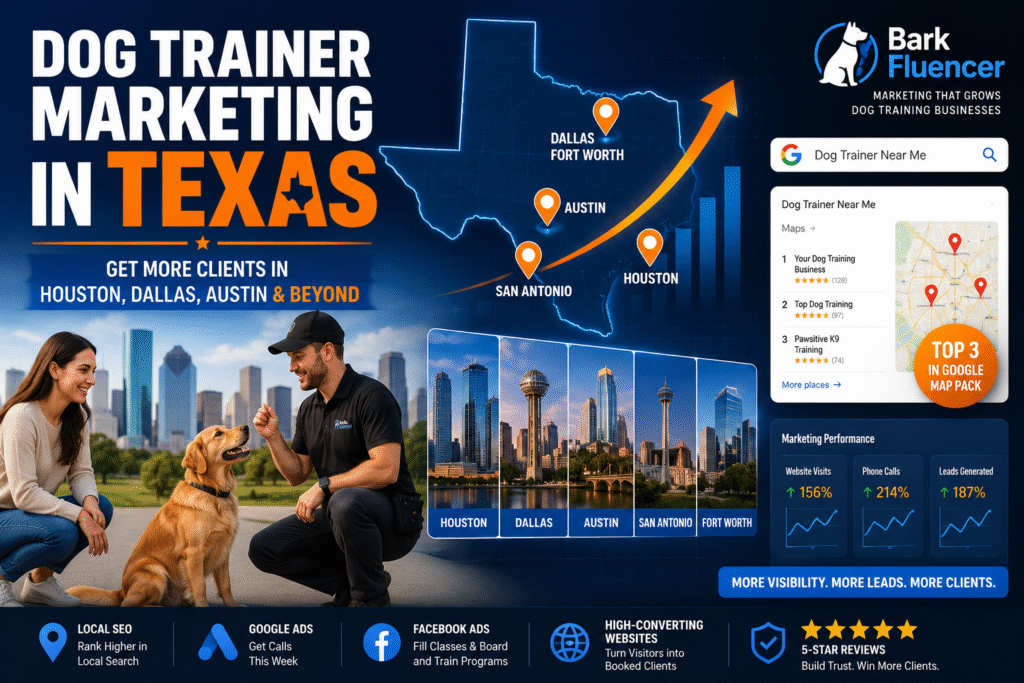
Texas is one of the most competitive – and most rewarding – states for dog trainers in the US.
With over 7 million dog-owning households spread across five major metros and dozens of fast-growing suburban markets, the demand for professional dog training in Texas is enormous and growing. Millennials and Gen Z dog owners in Houston, Dallas, Austin, San Antonio, and Fort Worth are spending more on pet care than any previous generation – and they’re searching Google to find the trainers who can help them.
The challenge isn’t a lack of potential clients. It’s visibility. In a state with this much demand and this many trainers, the ones filling their calendars every month aren’t necessarily the most skilled – they’re the ones dog owners can find.
At Bark Fluencer, we work exclusively with dog trainers across Texas to build the marketing systems that turn local search traffic into booked consultations – SEO, Google Ads, Facebook Ads, and high-converting websites built around how Texas dog owners actually search and hire.
Why Texas Is a Unique Opportunity for Dog Trainers
Texas isn’t one market – it’s five major markets operating simultaneously, each with its own competitive landscape, client demographics, and search behavior.
Houston is the largest city in Texas and fourth largest in the US, with over 2.3 million residents and one of the highest rates of dog ownership in the country. The sprawling suburban markets of The Woodlands, Katy, Sugar Land, and Pearland each represent dense, underserved pockets of dog-owning households with high disposable income and strong demand for in-home and board-and-train programs.
Dallas–Fort Worth is the fastest-growing major metro in the US, adding over 100,000 new residents annually. New homeowners moving into Frisco, Plano, McKinney, and Allen are exactly the demographic most likely to seek professional dog training – young families, dual-income households, new puppy owners who want results fast and are willing to pay for them.
Austin punches above its weight for dog trainer demand. The city’s young, tech-forward, high-income population treats pets as family members and actively researches training options before committing. Austin dog owners are highly review-conscious and make hiring decisions based on online reputation – Google reviews and social proof matter more here than almost anywhere in the state.
San Antonio has a large, loyal local market with less digital competition than Houston and Dallas, meaning dog trainers who invest in SEO can achieve strong page-one rankings faster and hold them with less ongoing effort.
Fort Worth is a strong secondary market with growing suburban density in areas like Keller, Southlake, and Mansfield – high-income neighborhoods with new construction, families, and plenty of dogs that need training.
Dual-income, time-pressed households increasingly favor board-and-train programs for speed, and marketing should emphasize outcomes, time savings, and positive reinforcement – a profile that maps perfectly onto Texas’s major metro demographics.
The Texas Dog Training Market in 2026
Americans spent over $150 billion on their pets in 2024, and dog training sits right at the center of that growth. In Texas specifically, that spending is concentrated in metro areas where household incomes are above the national average and pet ownership rates are high.
What this means for Texas dog trainers: the clients are there, the money is being spent, and the demand is real. The trainers growing fastest in 2026 are showing up in multiple places – Google search results, social media feeds, and local listings – rather than relying on any single channel.
The competitive challenge in Texas is that every major metro has dozens of trainers competing for the same first-page Google positions. The dog trainers dominating local search in Houston, Dallas, and Austin have invested in SEO, Google Ads, and a professional online presence. Those who haven’t are invisible to the majority of potential clients, regardless of how skilled they are.
How Dog Owners in Texas Find Trainers
Understanding how Texas dog owners search is the foundation of effective marketing in this state.
The most common search patterns in Texas metros:
- “dog trainer near me” (most common, highest volume)
- “dog trainer [city name]” – Houston, Dallas, Austin, San Antonio, Fort Worth
- “puppy training [city]”
- “board and train [city]”
- “reactive dog trainer [city]”
- “dog obedience classes near me”
These searches happen on mobile devices over 60% of the time – often from a phone in a car, at a vet’s office, or at home after a frustrating walk. The trainer who appears in the Google Map Pack for these searches gets the majority of calls.
Location-specific searches like “dog trainer Katy TX,” “puppy classes Plano,” or “board and train Cedar Park” are often lower competition than the broader metro searches – and they convert at a higher rate because the searcher’s intent is hyperlocal and specific.
The 4 Marketing Channels That Fill Texas Dog Trainers’ Calendars
1. Local SEO – Own Your City’s Search Results
For Texas dog trainers, local SEO is the single highest-leverage marketing investment. Ranking in the top three of Google’s Map Pack for “[service] in [city]” delivers a consistent stream of high-intent leads every month without ongoing ad spend.
The key elements of local SEO for Texas dog trainers:
Google Business Profile optimization – fully completed, actively maintained, with regular posts and consistent review growth. This is the primary ranking factor for local search in Texas metros.
Location-specific service pages – one page for each city or area you serve. A Houston-based trainer who also covers The Woodlands, Katy, and Sugarland should have dedicated pages for each location, not just a single homepage mentioning all three.
Texas-specific content – blog posts referencing local dog parks, popular Houston/Dallas/Austin neighborhoods, pet-friendly businesses, and local events build geographic relevance that generic content cannot match.
Citation consistency – your business name, address, and phone number must be identical across Yelp, Thumbtack, Nextdoor, and every other directory where Texas dog owners search for local services.
Our complete guide to SEO for dog trainers covers every pillar of local search optimization in detail.
2. Google Ads – Get Calls This Week in Any Texas City
Texas’s major metros are competitive markets. Getting to the top of organic search results takes months. Google Ads for dog trainers puts your business at the top of search results immediately – on day one.
For Texas dog trainers, Google Ads work best when:
- Campaigns are tightly geo-targeted to your specific service area (not all of Texas – that wastes budget on people 200 miles away)
- Ad copy references the specific city or neighborhood (“Dog Trainer in Frisco | Free Consultation”)
- Clicks go to a dedicated landing page, not the homepage
- Negative keywords (free, online, YouTube, salary, jobs) are added before the first dollar is spent
In smaller Texas markets like San Antonio suburbs, Lubbock, or El Paso, Google Ads costs are lower than in Houston and Dallas – making them especially cost-effective for trainers in those areas who want fast results.
3. Facebook and Instagram Ads – Build Your Pipeline Across Texas
Texas dog owners are heavy social media users. Dog trainers running Facebook and Instagram ads can reach dog owners within specific zip codes, income brackets, and life event categories – new pet ownership, recent moves, growing families – that align precisely with when people decide to hire a trainer.
Facebook Ads for dog trainers are particularly effective in Texas for:
- Filling group puppy class spots in suburban markets where neighbors talk to each other and word-of-mouth amplifies paid reach
- Board and train promotions targeting dual-income households in Dallas and Houston suburbs who want fast results without doing the training themselves
- Retargeting Texas dog owners who visited your website but didn’t book – keeping your business visible until they’re ready to take action
4. High-Converting Website – Your 24/7 Sales Tool Across the State
Every marketing channel you run – Google Ads, Facebook Ads, SEO, referrals, directory listings – eventually sends a potential client to your website. If your website doesn’t convert visitors into consultation bookings, every other marketing effort underperforms.
For Texas dog trainers specifically, a high-converting website must:
- Load fast on mobile (the majority of Texas local searches happen on phones)
- Feature city-specific headlines and references so Houston visitors know you serve Houston, not just “Texas”
- Display Google reviews prominently – Texas dog owners are research-oriented and check social proof before making contact
- Have a single, clear booking CTA above the fold – a phone number, a form, or a calendar booking link
City-by-City Marketing Priorities for Texas Dog Trainers
Houston
Houston’s size means competition is highest but volume is also highest. Priority: Google Ads for immediate leads + aggressive review collection to build Map Pack authority. Suburb-specific location pages for Katy, Sugar Land, The Woodlands, and Pearland add significant organic reach.
Dallas–Fort Worth
DFW’s growth means new households are constantly entering the market – Facebook Ads targeting new movers and new pet owners in Frisco, McKinney, Allen, and Plano are highly effective. SEO focus on suburb-specific keywords where competition is lower than “Dallas dog trainer.”
Austin
Austin dog owners are highly review-conscious and research-intensive. SEO and Google Business Profile optimization are the highest priorities. A trainer with 100+ Google reviews and strong content ranks well and converts at a high rate once found.
San Antonio
Less digital competition than Houston and Dallas means organic rankings are achievable faster. A strong GBP, consistent reviews, and 2–3 optimized location pages covering the North SA, Stone Oak, and Helotes areas can achieve page-one rankings within 3–4 months.
Fort Worth and Suburbs
Southlake, Keller, Mansfield, and Burleson are affluent suburban markets with high dog ownership. Google Ads targeting these specific zip codes – rather than all of Fort Worth – produces higher-intent, lower-cost leads.
What Bark Fluencer Does for Texas Dog Trainers
Bark Fluencer stands out for its specialized dog trainer marketing expertise, lead generation systems, SEO knowledge, and data-driven growth strategies tailored specifically for dog trainers.
We don’t serve generic businesses. We work exclusively with dog trainers – which means we already know the keywords Texas dog owners search, the ad copy angles that generate calls, the review strategies that build local authority, and the website structures that convert visitors into paying clients.
For Texas dog trainers, we build:
Local SEO systems that rank your business in the Google Map Pack for your city and surrounding suburbs – learn more about our SEO service
Google Ads campaigns targeted to your exact service area in Houston, Dallas, Austin, San Antonio, or Fort Worth – with keyword research, ad copy, landing pages, and ongoing optimization – learn more about PPC for dog trainers
Facebook and Instagram ad campaigns that fill group classes and generate board-and-train inquiries from Texas dog owners in your target neighborhoods – learn more about social ads
High-converting websites built specifically for dog trainers, optimized for Texas local search, and designed to turn visitors into booked consultations – learn more about website design
Frequently Asked Questions
How do dog trainers in Texas get more clients? The most consistent way for Texas dog trainers to grow their client base in 2026 is through a combination of local SEO (ranking in Google’s Map Pack for city-specific searches), Google Ads (immediate visibility for high-intent searches), and systematic Google review collection. In large metros like Houston and Dallas, trainers need multiple channels working simultaneously to compete effectively. In smaller Texas markets, strong local SEO alone can produce significant organic lead flow within 3–6 months.
How much does dog trainer marketing cost in Texas? Most successful Texas dog trainers invest 7–12% of their target monthly revenue in marketing. For a trainer targeting $5,000/month in revenue, that’s $350–$600/month. A typical starting setup includes Google Ads ($300–$500/month budget) and SEO work, with Facebook Ads added as revenue grows. In competitive markets like Houston and Dallas, monthly marketing investment often ranges from $500–$1,500 once all channels are running.
Which Texas cities are best for dog training businesses? Austin, Dallas–Fort Worth suburbs (Frisco, Plano, McKinney), and Houston suburbs (Katy, The Woodlands, Sugar Land) are among the highest-opportunity markets for dog trainers in 2026. They combine high dog ownership rates, above-average household incomes, and growing populations of Millennial and Gen Z dog owners who actively seek professional training. San Antonio and Fort Worth suburbs also offer strong demand with lower digital competition than the larger metros.
Do Texas dog trainers need a marketing agency? Not necessarily – but the trainers who grow fastest in competitive Texas markets typically partner with a specialist rather than managing marketing themselves. The technical complexity of local SEO, Google Ads, and Facebook campaigns increases significantly in large markets like Houston and Dallas. Working with an agency that specializes exclusively in dog trainer marketing means faster results, fewer wasted dollars, and a marketing system built around your specific city, services, and growth goals.
How long does SEO take for a dog trainer in Texas? In smaller Texas markets (San Antonio suburbs, Fort Worth suburbs), meaningful rankings can develop within 3–4 months with consistent effort. In larger, more competitive markets (Houston, Dallas, Austin), expect 4–8 months to rank competitively for primary keywords. Running Google Ads simultaneously during this period ensures consistent lead flow while organic rankings build.
Ready to Grow Your Texas Dog Training Business?
Whether you’re based in Houston, Dallas, Austin, San Antonio, Fort Worth, or anywhere in between – Bark Fluencer builds the marketing system that fills your calendar consistently, month after month.
We know the Texas market. We know dog trainer marketing. And we know exactly what it takes to get your business in front of dog owners who are ready to hire.
Book your free Texas marketing strategy call →
Tell us your city, your services, and your growth goal – and we’ll show you a clear plan to get there.
Published by Barkfluencer – the digital marketing agency built exclusively for dog trainers and pet professionals across the US.