If you run a dog training facility – a physical location with group classes, board-and-train suites, and more than one instructor on staff – you’re fighting a different marketing battle than a solo trainer working out of clients’ homes. You have overhead. You have kennels or classroom space to fill every week. And you’re usually competing against three or four other facilities in your metro area for the same “dog training near me” searches.
The good news: facilities have marketing advantages most solo trainers don’t – a real address, a team of trainers, before/after board-and-train stories, and enough volume to justify running Google Ads and SEO at the same time. This guide covers all four pieces you asked about – SEO, Google Ads, social media, and digital marketing strategy – specifically through the lens of a training facility, not a single trainer.
Quick answer: What does digital marketing for a dog training facility actually include?
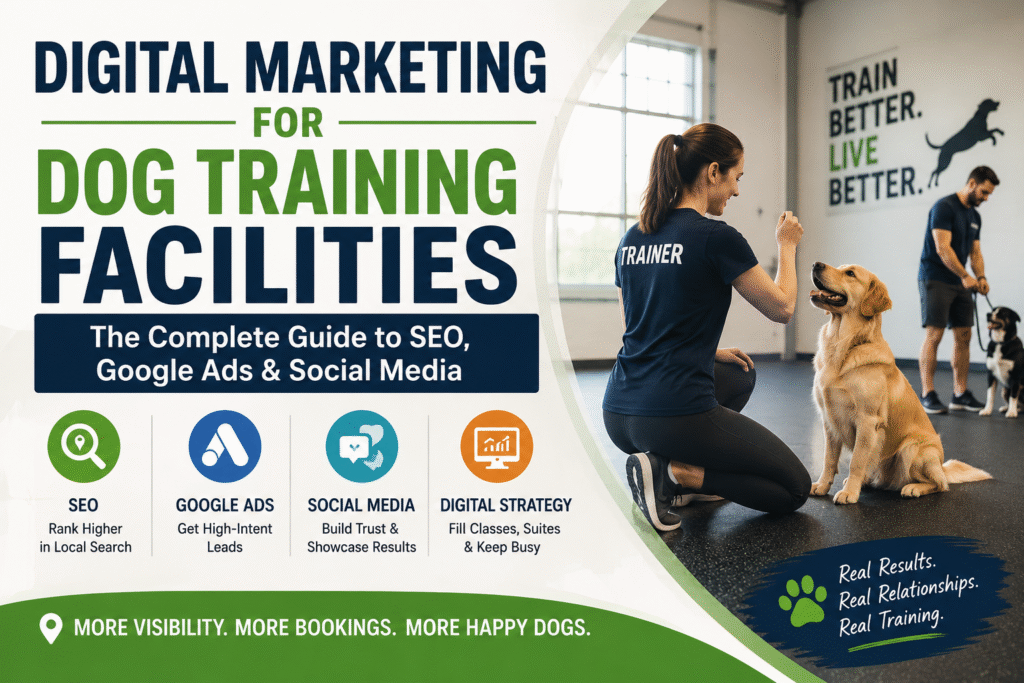
A complete digital marketing plan for a dog training facility combines four channels working together: local SEO (so you show up in Google’s Map Pack for “dog training near me”), Google Ads (paid visibility for high-intent searches like “board and train” or “puppy classes”), social media (video and photo proof from your facility that builds trust before someone calls), and a website built to convert that visitor into a booked evaluation or tour. Facilities that run all four consistently outperform those that rely on referrals or a single channel.
Why dog training facilities need a different strategy than individual trainers
Most marketing advice online is written for solo trainers. A facility has different assets and different problems:
- Multiple service lines to promote – group classes, private lessons, board-and-train, daycare, and sometimes boarding. Each needs its own landing page and keyword strategy.
- A physical location to defend – you need to win the local pack for your city and surrounding suburbs, not just rank nationally.
- Staff, not just a founder – your website and social content should showcase your full training team, not one personal brand, which actually strengthens trust signals (more on E-E-A-T below).
- Higher-ticket offers – board-and-train programs often run $1,500–$5,000+, which means your marketing has to build more trust before someone commits, and your ad budget needs tighter targeting to avoid wasted clicks.
- Capacity limits – unlike an in-home trainer, you have a fixed number of kennels or class slots, so your marketing goal shifts from “get more leads” to “keep the calendar consistently full without overbooking.”
If you want the broader picture of why trainers and facilities lose visibility in the first place, our lead generation guide for dog trainers breaks down the most common gaps we see before a facility ever calls us.
SEO for dog training facilities
Quick answer
SEO for a dog training facility centers on local SEO – an optimized Google Business Profile, city-specific service pages, and consistent name/address/phone (NAP) data – combined with content that answers the exact questions pet owners search before booking, like “how much does board and train cost” or “best puppy classes near me.”
1. Local SEO is non-negotiable
Local intent dominates this category. Roughly 46% of all Google searches carry local intent, and “near me” search volume continues to climb every year as Google increasingly infers location even when someone doesn’t type it. For a facility with a physical address, that’s an opportunity most solo trainers can’t fully capture:
- Claim and fully complete your Google Business Profile: categories, services, hours, photos of the actual facility, and posts published weekly.
- Keep your business name, address, and phone number identical across your website, GBP, Yelp, and Facebook.
- Collect reviews consistently – businesses that rank in the local map pack average well over 500 Google reviews, and review volume has a measurable, compounding effect on both rankings and conversion rate.
- Build one dedicated landing page per city or neighborhood you actually serve, each with unique content (not the same page duplicated with a new city name swapped in).
2. Structure content around what pet owners actually search
Instead of one generic “our training programs” page, build separate, keyword-specific pages for:
- Board and train programs
- Group obedience classes
- Puppy classes
- Private lessons
- Daycare (if offered)
- Behavior-specific programs (reactivity, aggression, separation anxiety)
Each page should target its own keyword cluster and answer the questions a pet owner has at that stage – price ranges, program length, what’s included, and what results to expect.
3. On-page fundamentals that still matter in 2026
- One clear H1 per page matching search intent, with descriptive H2/H3 subheadings.
- Fast load times and mobile-first design – the majority of local searches happen on a phone.
- Internal links between related pages (for example, linking your board-and-train page to a blog post about crate training, or your puppy class page to a post on socialization).
- Schema markup for LocalBusiness, Service, and FAQ so search engines – and AI answer engines – can parse your content accurately.
If your website wasn’t built with SEO and conversion in mind from the ground up, no amount of blogging will fix it. That’s the gap our SEO and website design services are built to close together, rather than treating them as separate projects.
Google Ads for dog training facilities
Quick answer
Google Ads works well for facilities because it puts you in front of pet owners the moment they search high-intent terms like “board and train near me” or “dog training facility [city]” – but it only pays off with tight keyword targeting, a strong negative keyword list, and a landing page built for the specific offer, not your homepage.
Build campaigns around your service lines, not your brand
A single “Dog Training” campaign wastes budget. Split campaigns by intent:
- Board and train – highest commercial intent, highest cost-per-click, but usually the best return per booking.
- Group classes / puppy classes – higher volume, lower price point, good for filling recurring class schedules.
- Behavior and reactivity programs – lower volume, very high intent, less price-sensitive.
Negative keywords save your budget
Without a strong negative keyword list, facility ads regularly burn spend on searches like “dog training jobs,” “how to train a dog myself,” “free dog training tips,” or breed-specific searches unrelated to your programs. Building this list out before launch – not after a month of wasted spend – is one of the fastest ways to improve return on ad spend.
Send traffic to a matching landing page
If someone clicks an ad for “board and train,” they should land on a page about board and train – pricing range, program length, what a typical day looks like, and a clear call to action – not your general homepage. Mismatched landing pages are one of the most common (and most expensive) mistakes we see facilities make; we cover more of these in 10 landing page mistakes dog trainers make.
For a deeper walkthrough of keyword selection and ad copy that converts, see our full breakdown in Google Ads for Dog Trainers: Exact Keywords, Negatives, and Ad Copy That Converts, or explore our Pay Per Click service if you’d rather have this managed for you.
Social media for dog training facilities
Quick answer
Social media for a dog training facility works best as proof, not promotion – short video of real training sessions, board-and-train transformations, and staff personalities, published consistently on Instagram, Facebook, and TikTok, because pet owners are trusting you with their dog and want to see how you actually work before they call.
What actually performs for training facilities
- Before/after board-and-train clips – the single most persuasive content format for this niche, because it shows tangible results.
- Behind-the-scenes of a training day – builds trust in your facility and your team, which matters more for a multi-trainer business than a solo brand.
- Staff introductions – pet owners want to know who is handling their dog. Introducing each trainer builds the kind of trust a facility needs to justify board-and-train pricing.
- Client testimonials on video – far more persuasive than written reviews alone.
- Educational short-form content – quick tips answer common questions and keep you visible between bookings, while also feeding the same content pool that AI search tools increasingly pull from (more below).
Consistency beats production value
A facility posting three simple, authentic videos a week will consistently outperform one polished video posted once a month. Platforms reward consistency, and pet owners respond to authenticity over polish in this category.
If content creation and posting is the piece you keep dropping, our Social Media Management and Facebook & Instagram Ads services are built specifically to keep a facility’s feed active without it falling on you or your lead trainer.
AEO and GEO: optimizing for AI search, not just Google
Search behavior has genuinely shifted. AI Overviews now appear on a large and growing share of local searches, and a meaningful share of consumers already ask ChatGPT, Gemini, or Claude for local business recommendations instead of typing into Google. That means “ranking” now means two things: ranking in traditional search results, and being the source an AI answer engine actually cites or recommends.
Answer Engine Optimization (AEO) and Generative Engine Optimization (GEO) for a training facility come down to a few practical habits:
- Write content that directly answers a question in the first sentence or two (“Board and train programs typically run 2–4 weeks and cost $1,500–$4,500 depending on the dog’s needs”) before expanding with detail. AI systems and Google’s AI Overviews both favor content structured this way.
- Use FAQ schema on service pages so the exact question-and-answer format is machine-readable.
- Keep your facility’s name, services, and pricing ranges consistent everywhere they appear online – AI tools cross-reference multiple sources, and inconsistent information gets filtered out.
- Earn mentions on local “best of” lists, pet blogs, and directories – AI answer engines weight citations and third-party mentions heavily, more than backlinks alone.
We go deeper on this shift in What Is AEO? Why Dog Trainers Need Answer Engine Optimization in 2026, which applies just as directly to a facility as it does to a solo trainer.
E-E-A-T: why trust signals matter more for facilities
Google’s quality guidelines reward Experience, Expertise, Authoritativeness, and Trust – and this matters more for a facility than almost any other pet business type, because you’re asking someone to leave their dog with you overnight. Strengthen these signals by:
- Publishing real trainer bios with certifications, years of experience, and specialties on your website – not a generic “our team” paragraph.
- Featuring genuine client testimonials and video reviews, tied to real names where possible.
- Showing your actual facility – kennels, training areas, outdoor space – in photos and video, not stock imagery.
- Keeping a visible, consistent presence across Google Business Profile, your website, and social media, since AI and search systems both check for that consistency as a trust signal.
- Publishing helpful, accurate training content on your blog, which does double duty: it demonstrates expertise and it feeds your SEO and AEO strategy at the same time.
The pet industry backdrop: why competition keeps rising
Dog training facilities aren’t imagining the increased competition. U.S. pet industry spending reached $158 billion in 2025 and is projected to climb to roughly $165 billion in 2026, and dog-owning households grew to about 71 million – an increase of roughly 4 million households in a single year. More dog owners means more demand for training, but it also means more facilities and trainers entering the market to capture it. Facilities that combine SEO, Google Ads, social proof, and AI-search readiness are the ones capturing that growth instead of splitting it eight ways with local competitors.
Common questions about marketing a dog training facility
How much should a dog training facility spend on marketing? Most facilities see the best results budgeting roughly 7–12% of revenue toward marketing, split between SEO/content (ongoing, compounding) and paid ads (immediate, capped by budget). Facilities just opening or expanding into a new city often front-load ad spend while SEO builds momentum in the background.
Is SEO or Google Ads better for a dog training facility? They solve different problems. Google Ads produces leads almost immediately but stops the moment you stop paying. SEO takes months to build but keeps producing leads with no per-click cost once you rank. Most facilities need both – ads while SEO is being built, then a gradual shift as organic rankings mature.
Which social platform matters most for a training facility? Instagram and Facebook still drive the most bookings for training facilities because pet owners in your local area are already active there, but TikTok and Instagram Reels are where board-and-train transformation content gets the most reach for a relatively small time investment.
Do I need a marketing agency, or can I run this myself? Many facility owners start by managing marketing themselves and shift to an agency once the time cost outweighs the savings – usually when class schedules and board-and-train bookings pick up. If you’re weighing that decision, how to choose a dog marketing agency walks through what to look for.
Putting it together
SEO, Google Ads, social media, and AI-search visibility aren’t separate projects for a dog training facility – they reinforce each other. Ads bring in bookings while SEO is compounding in the background. Social media builds the trust that turns an ad click or a search result into a phone call. And consistent, accurate information across every channel is exactly what both Google and AI answer engines reward with visibility.
If you’d rather have all four running together instead of piecing it together yourself, book a free 30-minute strategy call and we’ll walk through where your facility is losing visibility right now – and what to fix first.
Written by the Barkfluencer team — a marketing agency working exclusively with dog trainers and dog training facilities across the U.S. Learn more about our approach or explore our full range of services.